
Artificial intelligence systems learn patterns by processing data through mathematical models. At the core of many machine learning and deep learning systems is the artificial neural network, a computational architecture inspired loosely by the way biological neurons process information. Neural networks can identify complex patterns in images, text, speech, numerical data, and other forms of information by learning relationships between inputs and outputs.
One of the most important components inside a neural network is the activation function. An activation function determines how strongly a neuron should respond after receiving its weighted inputs. It also introduces nonlinearity into the network, allowing multiple neural layers to learn complex relationships that a simple linear model cannot represent.

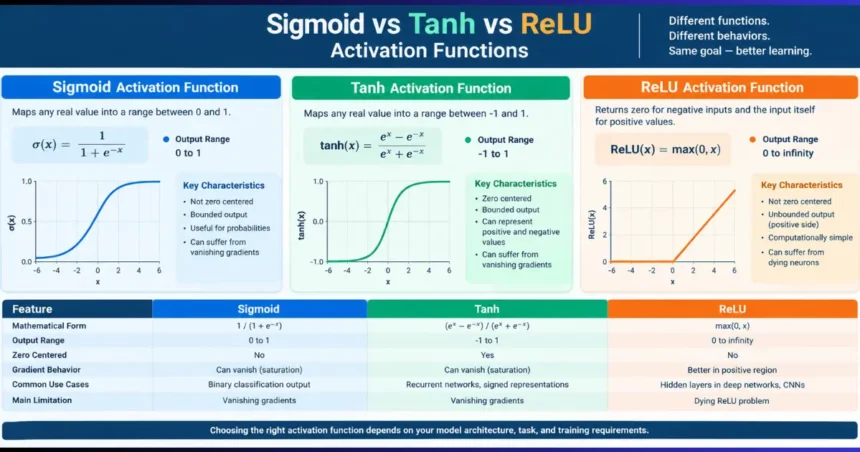
Among the many activation functions used in neural networks, Sigmoid, Tanh, and ReLU are particularly important for understanding how deep learning models evolved. Sigmoid and Tanh were widely used in earlier neural networks and remain useful in specific situations. ReLU became highly important in modern deep learning because it is computationally simple and generally provides better gradient behavior in deep networks.
Choosing an activation function is not simply a matter of selecting the newest or most popular option. The appropriate function depends on the architecture, output requirements, optimization method, and type of prediction being performed.
This article explains how Sigmoid, Tanh, and ReLU work mathematically, how gradients behave during backpropagation, where each function is useful, and how they compare in practical deep learning applications.
What Is an Artificial Neural Network?
An artificial neural network is a computational model composed of interconnected artificial neurons. Each neuron receives one or more input values, assigns importance to those inputs using weights, adds a bias, and then passes the resulting value through an activation function.
A simplified neuron can be represented as:
z = w₁x₁ + w₂x₂ + w₃x₃ + b
The activation function then transforms this value:
y = f(z)
Where:
x represents an input.
w represents a learned weight.
b represents the bias.
z represents the weighted sum before activation.
f represents the activation function.
y represents the neuron output.
During training, the neural network adjusts its weights and biases to reduce the difference between predicted outputs and actual target values.
How a Neural Network Learns
Consider an image classification model that receives an image of a cat.
The input layer receives numerical representations of the image. Hidden layers progressively extract useful patterns. Earlier layers may respond to edges and simple shapes, while deeper layers can recognize combinations of shapes and more meaningful visual structures.
The final layer produces a prediction.
Activation functions make this hierarchical learning possible because they introduce nonlinear transformations between layers.
Without nonlinear activation functions, stacking multiple linear layers would still produce a mathematical function that behaves as a linear transformation. That would severely limit the complexity of relationships the network could learn.
Why Are Activation Functions Important?
Activation functions serve several important purposes in neural networks.
They Introduce Nonlinearity
Real world data is rarely governed by simple linear relationships. Image recognition, speech recognition, language understanding, and many other AI tasks involve highly nonlinear relationships.
If every layer only performed a linear transformation, increasing the number of layers would not provide the expected expressive power.
A nonlinear activation function allows the network to approximate complex functions.
They Control Neuron Output
An activation function transforms the neuron’s weighted input into an output value. Depending on the function, this output can be bounded or unbounded.
For example, Sigmoid produces values between 0 and 1, while ReLU produces values from 0 toward positive infinity.
They Affect Gradient Based Learning
Modern neural networks are commonly trained using gradient based optimization. During backpropagation, gradients are calculated and propagated through the network.
The derivative of the activation function directly affects these gradients.
If gradients become extremely small, learning can become slow or effectively stop in earlier layers. This behavior is associated with the vanishing gradient problem.
If gradients become excessively large, optimization can become unstable. This is associated with exploding gradients.
Therefore, activation functions influence both the representation power and the optimization behavior of a neural network.
What Is the Sigmoid Activation Function?
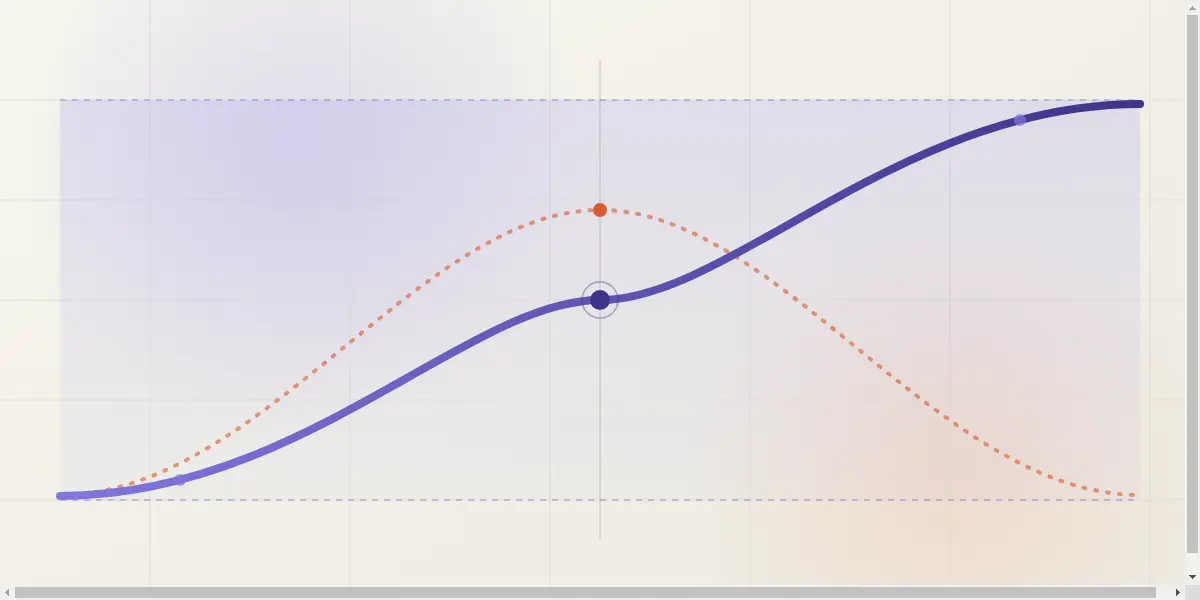
The Sigmoid activation function, also called the logistic function, maps any real valued input into a value between 0 and 1.
Its mathematical definition is:
σ(x) = 1 / (1 + e⁻ˣ)
The output approaches 0 when the input becomes strongly negative and approaches 1 when the input becomes strongly positive.
Sigmoid Output Range
The output range is:
0 < σ(x) < 1
For example:
| Input | Approximate Sigmoid Output |
|---|---|
| −5 | 0.0067 |
| −2 | 0.1192 |
| 0 | 0.5000 |
| 2 | 0.8808 |
| 5 | 0.9933 |
This bounded output makes Sigmoid particularly useful when a neural network needs to represent a probability.
Sigmoid Derivative
An important mathematical property of Sigmoid is that its derivative can be written using the function itself:
σ′(x) = σ(x)(1 − σ(x))
The maximum derivative occurs around the center of the function and is only 0.25.
As the input becomes strongly positive or strongly negative, the derivative approaches zero.
This property creates an important optimization limitation.
The Vanishing Gradient Problem With Sigmoid
During backpropagation, gradients are multiplied through multiple layers. If an activation function repeatedly produces derivatives close to zero, the gradient can become extremely small as it moves backward through the network.
For Sigmoid, saturation occurs at both extremes.
When x is very positive:
σ(x) ≈ 1
When x is very negative:
σ(x) ≈ 0
In both cases:
σ′(x) ≈ 0
As a result, neurons operating in saturated regions provide very small gradients.
In a sufficiently deep network, repeated multiplication by small derivatives can cause gradients reaching earlier layers to become extremely small.
This is the vanishing gradient problem.
Is Sigmoid Still Useful?
Yes. Sigmoid has not become obsolete.
It remains particularly useful when the output represents the probability of a binary event.
For example, a binary classification model predicting whether an email is spam can use a Sigmoid output:
P(spam) = σ(z)
A prediction close to 0 means the model considers the negative class more likely, while a prediction close to 1 means the positive class is more likely.
Sigmoid is therefore commonly associated with binary classification output layers rather than the hidden layers of modern deep networks.
Advantages of Sigmoid
Sigmoid has several useful characteristics.
It produces a smooth output.
Its output can be interpreted naturally as a probability when used appropriately.
It is differentiable everywhere.
It works well with binary classification objectives such as binary cross entropy.
It provides a mathematically bounded output.
Limitations of Sigmoid
Sigmoid also has important limitations.
It is not zero centered.
It can saturate at large positive and negative inputs.
Its gradients can become very small.
Its exponential calculation is more computationally expensive than simple piecewise functions such as ReLU.
For these reasons, Sigmoid is generally not the default activation function for hidden layers in modern deep neural networks.
What Is the Tanh Activation Function?
The hyperbolic tangent function, commonly called Tanh, is another nonlinear activation function.
Its mathematical definition is:
tanh(x) = (eˣ − e⁻ˣ) / (eˣ + e⁻ˣ)
Tanh maps an input into the range from −1 to 1.
Tanh Output Range
| Input | Approximate Tanh Output |
|---|---|
| −3 | −0.9951 |
| −1 | −0.7616 |
| 0 | 0 |
| 1 | 0.7616 |
| 3 | 0.9951 |
Unlike Sigmoid, Tanh is centered around zero.
This is one of its important advantages.
Tanh Derivative
The derivative of Tanh is:
tanh′(x) = 1 − tanh²(x)
The derivative reaches its maximum value of 1 when the input is zero.
However, just like Sigmoid, the derivative approaches zero when the input becomes strongly positive or strongly negative.
Therefore, Tanh can also suffer from the vanishing gradient problem.
Why Is Tanh Zero Centered?
A zero centered activation function produces both positive and negative outputs.
Sigmoid produces values between 0 and 1, so its output is always positive.
Tanh produces values between −1 and 1, meaning that its outputs can represent positive, negative, and neutral activation states.
This can provide more balanced signal propagation in certain networks.
Historically, this made Tanh attractive for neural network hidden layers and recurrent architectures.
Advantages of Tanh
Tanh has several useful properties.
It is zero centered.
Its output range is bounded.
It is smooth and differentiable.
It can represent both positive and negative activation values.
Its derivative reaches a maximum magnitude of 1 around zero.
Tanh can be useful in recurrent neural networks and architectures where signed internal states are meaningful.
Limitations of Tanh
The major limitation is saturation.
When the absolute value of the input becomes large, Tanh approaches either −1 or 1.
Consequently:
tanh′(x) ≈ 0
in those regions.
Therefore, deep networks using Tanh extensively can still experience vanishing gradients.
Tanh also requires exponential calculations, making it more computationally expensive than ReLU.
What Is the ReLU Activation Function?
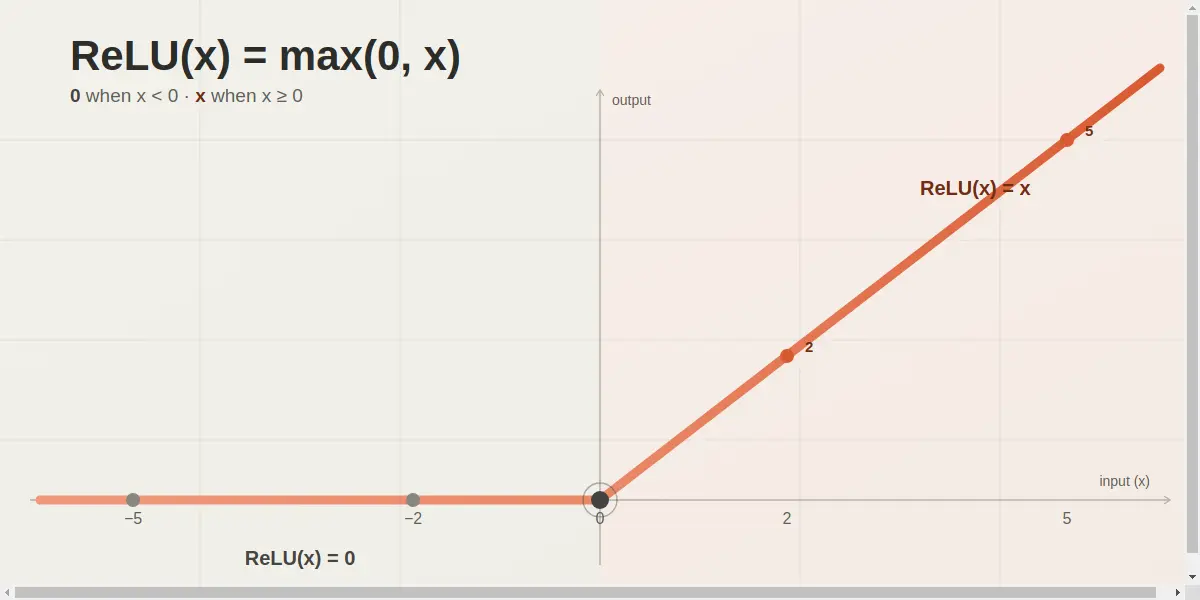
ReLU stands for Rectified Linear Unit.
It is one of the most widely used activation functions for hidden layers in deep neural networks.
The mathematical definition is:
ReLU(x) = max(0, x)
This means:
ReLU(x) = 0 when x < 0
ReLU(x) = x when x ≥ 0
Unlike Sigmoid and Tanh, ReLU does not compress positive values into a fixed upper range.
ReLU Output Range
The theoretical output range is:
0 to positive infinity
For example:
| Input | ReLU Output |
|---|---|
| −5 | 0 |
| −2 | 0 |
| 0 | 0 |
| 2 | 2 |
| 5 | 5 |
This simple mathematical behavior is one of the reasons ReLU became so important in deep learning.
Why Does ReLU Work Well in Deep Networks?
For positive inputs, the derivative of ReLU is:
ReLU′(x) = 1
This means the gradient does not shrink because of the activation function itself when the neuron operates in its positive region.
That is substantially different from Sigmoid and Tanh, whose derivatives approach zero in saturated regions.
ReLU therefore helps gradient based optimization work more effectively in many deep architectures.
It is also computationally inexpensive because it requires a simple threshold operation rather than an exponential calculation.
The Dying ReLU Problem
ReLU is not perfect.
For negative inputs, the output is zero and the derivative is also zero.
If a neuron consistently receives negative inputs, its gradient may remain zero during training. The neuron can effectively stop contributing to learning.
This behavior is commonly called the dying ReLU problem.
It can occur when neurons become stuck in the negative region.
Several alternative activation functions were developed partly to address this limitation.
Examples include Leaky ReLU, Parametric ReLU, ELU, GELU, and related functions.
ReLU Variants
Leaky ReLU
Leaky ReLU allows a small negative slope instead of returning exactly zero for every negative input.
A simplified definition is:
f(x) = x when x ≥ 0
f(x) = αx when x < 0
where α is a small positive value.
This allows some gradient to flow through the negative region.
Parametric ReLU
Parametric ReLU is similar to Leaky ReLU, but the negative slope can become a learned parameter.
This gives the network additional flexibility.
GELU
The Gaussian Error Linear Unit, commonly called GELU, is widely associated with modern Transformer based architectures.
GELU provides a smooth nonlinear transformation and differs mathematically from ReLU.
It has become particularly important in modern language models and Transformer architectures.
This demonstrates an important point: ReLU is highly influential, but modern AI systems often use more specialized activation functions depending on architecture and optimization requirements.
Sigmoid vs Tanh vs ReLU
The three functions differ significantly in their mathematical behavior.
| Property | Sigmoid | Tanh | ReLU |
|---|---|---|---|
| Mathematical form | 1 / (1 + e⁻ˣ) | tanh(x) | max(0,x) |
| Output range | 0 to 1 | −1 to 1 | 0 to infinity |
| Zero centered | No | Yes | No |
| Saturation | Yes | Yes | Positive side does not saturate |
| Vanishing gradient risk | High | High | Lower in positive region |
| Negative outputs | No | Yes | No |
| Computation | Relatively expensive | Relatively expensive | Very inexpensive |
| Common hidden layer use | Limited | Selective | Common |
| Binary probability output | Excellent | Not standard | Not suitable |
| Main limitation | Vanishing gradients | Vanishing gradients | Dying neurons |
Gradient Behavior Comparison
Gradient behavior is one of the most important differences between these activation functions.
| Activation | Positive Region Derivative | Negative Region Derivative | Main Gradient Concern |
|---|---|---|---|
| Sigmoid | Approaches 0 at large values | Approaches 0 at large negative values | Vanishing gradients |
| Tanh | Approaches 0 at large values | Approaches 0 at large negative values | Vanishing gradients |
| ReLU | 1 | 0 | Dying ReLU |
This table explains why ReLU became so important in deep learning.
For positive inputs, ReLU preserves the gradient magnitude at 1. Sigmoid and Tanh, in contrast, can produce very small derivatives when they saturate.
When Should You Use Sigmoid?
Sigmoid is particularly useful when the output of a model needs to represent a value between 0 and 1.
A common example is binary classification.
Suppose a model predicts whether a transaction is fraudulent.
The final layer can calculate:
p = σ(z)
The resulting value can be interpreted as the model’s estimated probability for the positive class when the model and loss function are configured appropriately.
Sigmoid is also useful in multilabel classification, where each output node can independently represent the probability of a particular label.
When Should You Use Tanh?
Tanh can be useful when the model benefits from zero centered activations.
It has historically played an important role in recurrent neural networks, particularly in architectures such as Long Short Term Memory networks and Gated Recurrent Units.
For example, an LSTM uses nonlinear transformations involving Tanh and Sigmoid to regulate information flowing through its internal state.
Tanh is also useful when a model needs bounded signed values.
When Should You Use ReLU?
ReLU is commonly used in hidden layers of feedforward neural networks and many deep learning architectures.
It is especially common in convolutional neural networks used for computer vision.
For example, a convolutional network may apply:
Convolution → ReLU → Pooling
across several stages.
The convolution extracts features while ReLU introduces nonlinear behavior.
ReLU can also produce sparse activations because negative inputs become zero. This means that only some neurons may be active for a particular input.
Practical Example
Imagine a neural network designed to classify images.
The input consists of pixel values.
The first hidden layer calculates weighted combinations of these pixels.
The resulting values are passed through ReLU.
Some neurons produce zero because their calculated values are negative. Other neurons produce positive values.
The next layer receives these transformed representations and identifies more complex patterns.
After multiple layers, the final layer produces a classification.
If the task is binary classification, a Sigmoid output can produce a probability for the positive class.
If the task involves multiple mutually exclusive classes, a Softmax output is typically more appropriate.
This demonstrates that activation function selection can differ between hidden layers and the output layer.
Activation Functions and Loss Functions
Activation functions should not be considered independently from the loss function.
For binary classification, a common combination is a Sigmoid output with binary cross entropy.
The binary cross entropy loss can be expressed as:
L = −[y log(p) + (1 − y)log(1 − p)]
where y is the target and p is the predicted probability.
For multiclass classification, Softmax is commonly paired with categorical cross entropy.
For regression tasks, the output layer often uses a linear activation when the prediction can take arbitrary real values.
Therefore, the correct activation depends strongly on what the output is supposed to represent.
Activation Functions in Modern Deep Learning
The development of activation functions reflects the evolution of neural network architectures.
Sigmoid and Tanh were particularly important in earlier neural networks and remain useful in specific contexts.
ReLU helped make training deep neural networks more practical by providing a simple nonlinear transformation with favorable gradient behavior for positive inputs.
Modern architectures have expanded the activation function landscape.
Transformer models commonly use functions such as GELU or related smooth nonlinear transformations.
Some architectures use specialized gated activations.
The important lesson is that there is no universally perfect activation function.
Activation selection should be based on the mathematical requirements of the architecture and the behavior required from the model.
Computational Efficiency
Computational cost matters when neural networks are trained on millions or billions of parameters.
ReLU is extremely simple:
max(0,x)
This can be evaluated efficiently on modern hardware.
Sigmoid and Tanh require exponential operations, although optimized hardware libraries make these calculations highly practical.
The computational difference becomes more relevant when activation functions are evaluated billions of times during large scale training.
Comparison of Advantages and Disadvantages
| Activation | Advantages | Disadvantages |
|---|---|---|
| Sigmoid | Smooth, bounded, useful for probabilities | Saturation, vanishing gradients, not zero centered |
| Tanh | Zero centered, bounded, useful for signed states | Saturation, vanishing gradients |
| ReLU | Simple, fast, strong gradient in positive region, sparse activations | Zero gradient for negative inputs, possible dying neurons |
Common Mistakes When Choosing an Activation Function
Using Sigmoid in Every Hidden Layer
Sigmoid is mathematically valid but can create optimization difficulties in deep networks because of saturation and small gradients.
Assuming ReLU Is Always the Best Choice
ReLU is highly useful, but it is not universally optimal.
Different architectures can benefit from different activation functions.
Ignoring the Output Layer
The activation function required for the final layer depends on the prediction task.
Binary classification, multiclass classification, multilabel classification, and regression can require different output configurations.
Ignoring Initialization and Optimization
Activation behavior also interacts with weight initialization, normalization, learning rate, architecture depth, and optimization algorithms.
A good activation function alone does not guarantee effective training.
Quick Decision Guide
| Machine Learning Requirement | Common Activation Choice |
|---|---|
| Binary classification output | Sigmoid |
| Multilabel classification output | Sigmoid |
| Hidden layers in many deep networks | ReLU or a modern variant |
| Bounded signed hidden representation | Tanh |
| Certain recurrent network states | Tanh |
| Multiclass classification output | Softmax |
| Unbounded regression output | Linear |
| Modern Transformer architectures | GELU or related functions |
These are general patterns rather than universal rules. Architecture design and experimentation remain important.
Frequently Asked Questions
What is an activation function in deep learning?
An activation function transforms the weighted input of a neuron before the result is passed to another layer. Its primary purpose is to introduce nonlinearity so that a neural network can learn complex relationships.
Why is ReLU commonly used instead of Sigmoid?
ReLU generally provides better gradient behavior in its positive region and is computationally simple. Sigmoid can saturate and produce very small gradients, which can make training deep networks more difficult.
Is Tanh better than Sigmoid?
Tanh has an important advantage because it is zero centered and produces values between −1 and 1. However, it can still suffer from saturation and vanishing gradients. Whether it is more appropriate depends on the architecture and task.
Can ReLU produce negative values?
No. Standard ReLU produces zero for negative inputs and returns the input value for positive inputs.
What is the dying ReLU problem?
The dying ReLU problem occurs when a ReLU neuron remains in its negative input region. Because the derivative is zero there, the neuron may stop receiving useful gradient updates.
Does ReLU completely solve the vanishing gradient problem?
No. ReLU reduces one important source of vanishing gradients because its derivative is 1 for positive inputs. However, deep neural networks can still experience gradient related problems due to architecture, initialization, normalization, optimization, and other factors.
Why is Sigmoid useful for binary classification?
Sigmoid converts a real valued logit into a value between 0 and 1. This makes it suitable for representing the probability of a positive class when used with an appropriate training objective.
Why is Tanh used in recurrent neural networks?
Tanh provides a bounded, zero centered representation and can help recurrent architectures maintain signed internal states. Classic recurrent architectures such as LSTM and GRU use Tanh and Sigmoid for different roles.
Which activation function should beginners learn first?
For understanding neural network fundamentals, learning Sigmoid, Tanh, and ReLU together is useful because they demonstrate three important ideas: bounded probability like output, zero centered nonlinear output, and efficient piecewise nonlinear activation.
Are Sigmoid, Tanh, and ReLU still used in modern AI?
Yes. Their roles have changed as neural network architectures have evolved. ReLU and its variants remain important, while Sigmoid and Tanh continue to be useful in output layers, recurrent architectures, and specialized components. Modern architectures also use functions such as GELU and other variants.
Conclusion
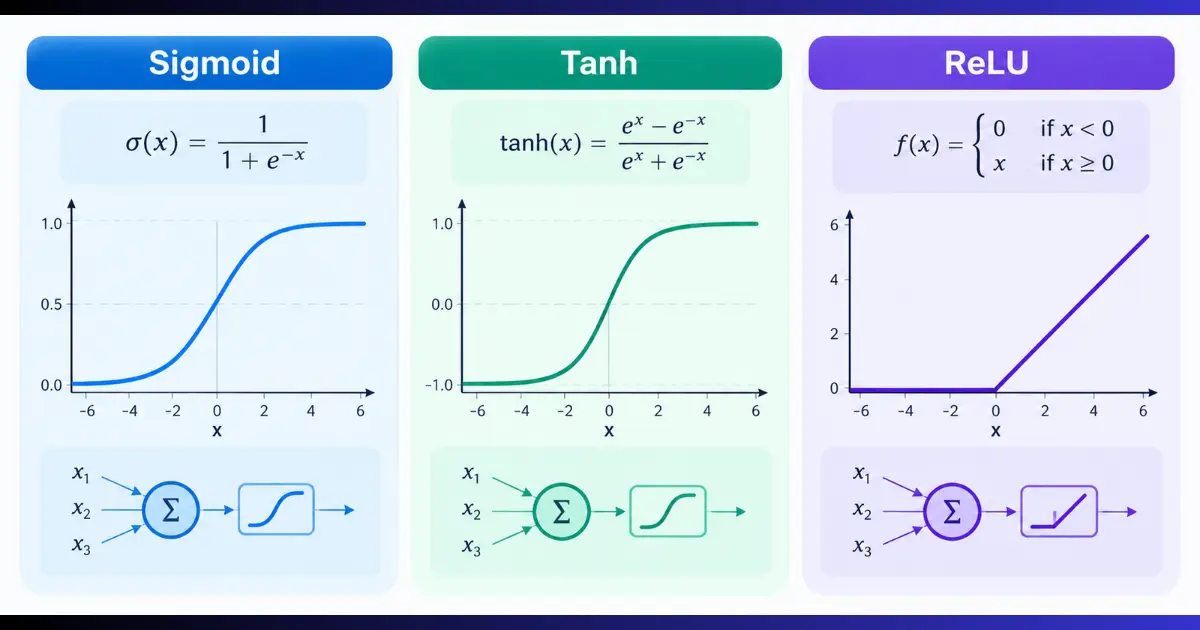
Sigmoid, Tanh, and ReLU represent three important stages in understanding neural network activation functions.
Sigmoid transforms values into the range from 0 to 1, making it particularly useful for binary and multilabel classification outputs. Its major limitation is saturation, which can result in very small gradients during backpropagation.
Tanh produces values between −1 and 1 and is zero centered. This makes it useful when a network benefits from signed internal representations. However, Tanh can also saturate and suffer from vanishing gradients.
ReLU uses a much simpler transformation. It returns zero for negative inputs and the original input for positive values. Its strong gradient behavior in the positive region and computational simplicity have made it a common choice for hidden layers in deep learning. However, ReLU can suffer from the dying neuron problem.
The most important lesson is that activation functions should not be selected based only on popularity. Their mathematical properties must be considered alongside the network architecture, task, output representation, loss function, optimization method, and training behavior.
Understanding these differences provides a strong foundation for studying modern deep learning architectures. Once the behavior of Sigmoid, Tanh, and ReLU is clear, concepts such as gradient descent, backpropagation, recurrent networks, convolutional networks, Transformers, and modern activation variants become much easier to understand.

Alex is an AI technology writer and researcher at AiVoogle, specializing in AI tools, emerging technologies, productivity solutions, and practical applications of artificial intelligence.
He researches the latest AI platforms and technologies to help readers discover useful tools and understand how they can be applied to content creation, business, marketing, productivity, design, research, and everyday workflows.
At AiVoogle, Alex contributes detailed AI tool reviews, comparisons, tutorials, how-to guides, and technology insights. His goal is to make rapidly changing AI technologies easier to understand and more useful for readers at every level.
Areas of expertise: AI Tools, Generative AI, AI Productivity, AI Software, AI Automation, AI Technology, Tool Reviews, AI Comparisons, and Emerging Technology.