
What Is Echelon Form of a Matrix?
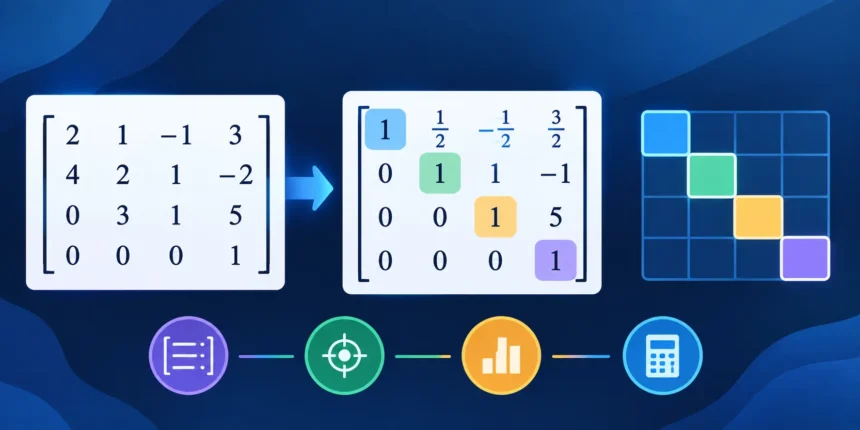
Echelon form of a matrix is a simplified arrangement of a matrix in which the nonzero rows form a staircase pattern from left to right. It is mainly used to solve systems of linear equations, identify pivots, determine the rank of a matrix, and simplify matrix calculations.
In simple words, a matrix is in echelon form when its leading nonzero entries move to the right as you move down the rows, and the entries below each leading entry are zero.
For example:
[123045006]\begin{bmatrix} 1 & 2 & 3\\ 0 & 4 & 5\\ 0 & 0 & 6 \end{bmatrix}
has a staircase structure, so it is in row echelon form.
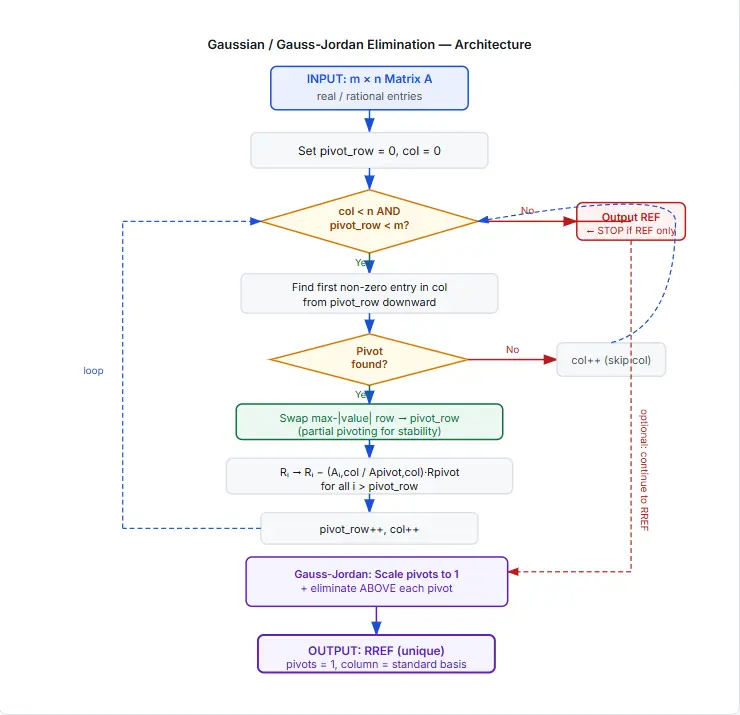
The process of converting a matrix into this form is commonly called Gaussian elimination. It uses elementary row operations such as row interchange, multiplying a row by a nonzero constant, and adding a multiple of one row to another.
Quick definition
Echelon form of a matrix is a form in which all zero rows are at the bottom, each leading entry is farther right than the leading entry in the row above, and all entries below each leading entry are zero.
Some textbooks additionally require every leading entry to be 1. Others use the more general definition where a leading entry only needs to be nonzero. This difference in convention is important when comparing textbooks or online explanations.
Echelon Form of a Matrix: Definition
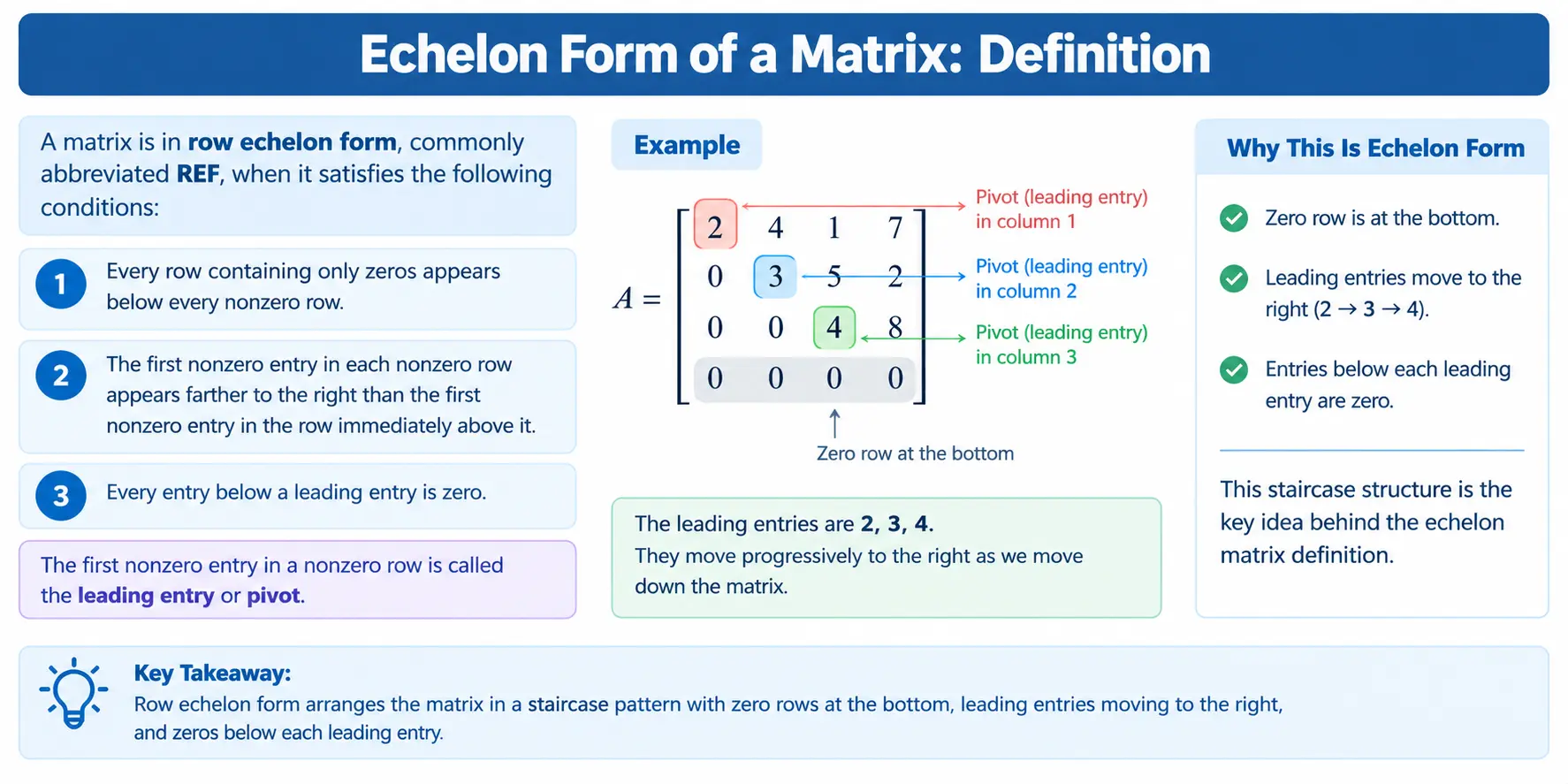
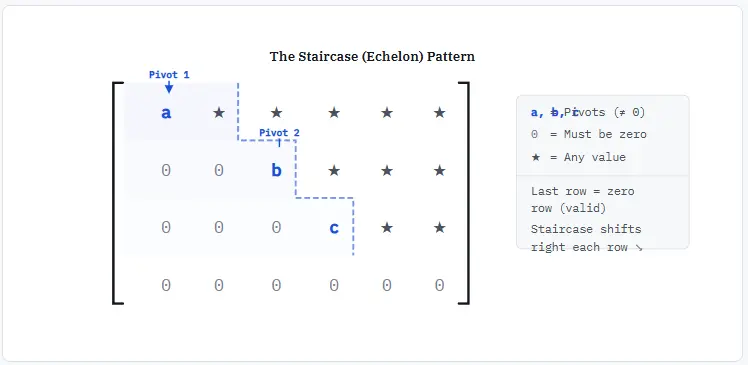
A matrix is in row echelon form, commonly abbreviated REF, when it satisfies these conditions:
- Every row containing only zeros appears below every nonzero row.
- The first nonzero entry in each nonzero row appears farther to the right than the first nonzero entry in the row immediately above it.
- Every entry below a leading entry is zero.
The first nonzero entry in a nonzero row is called the leading entry or pivot.
For example:
A=[2417035200480000]A= \begin{bmatrix} 2 & 4 & 1 & 7\\ 0 & 3 & 5 & 2\\ 0 & 0 & 4 & 8\\ 0 & 0 & 0 & 0 \end{bmatrix}
is in row echelon form.
The leading entries are:
2,3,42,\quad3,\quad4
They move progressively to the right as we move down the matrix.
The last row contains only zeros, so it correctly appears at the bottom.
This staircase structure is the key idea behind the echelon matrix definition.
What Does Echelon Form Mean?
The word echelon describes a staircase-like arrangement.
Think about the following matrix:
[1234015600170001]\begin{bmatrix} 1 & 2 & 3 & 4\\ 0 & 1 & 5 & 6\\ 0 & 0 & 1 & 7\\ 0 & 0 & 0 & 1 \end{bmatrix}
The leading entries form a staircase:
1→1→1→1\boxed{1} \quad\rightarrow\quad \boxed{1} \quad\rightarrow\quad \boxed{1} \quad\rightarrow\quad \boxed{1}
Each new leading entry is farther to the right.
That is why echelon form in matrices is often described as a staircase form.
What Is an Echelon Matrix?
An echelon matrix is a matrix that satisfies the conditions for row echelon form.
For example:
[147025003]\begin{bmatrix} 1 & 4 & 7\\ 0 & 2 & 5\\ 0 & 0 & 3 \end{bmatrix}
is an echelon matrix.
Another example is:
[025800340000]\begin{bmatrix} 0 & 2 & 5 & 8\\ 0 & 0 & 3 & 4\\ 0 & 0 & 0 & 0 \end{bmatrix}
The first leading entry occurs in column 2, the second in column 3, and the zero row is at the bottom.
Therefore, it is also in echelon form.
What Is Row Echelon Form?
Row echelon form is the standard form usually meant when people ask for the echelon form of a matrix.
A matrix is in row echelon form when its nonzero rows form a staircase pattern.
Consider:
A=[1357014600290000]A= \begin{bmatrix} 1 & 3 & 5 & 7\\ 0 & 1 & 4 & 6\\ 0 & 0 & 2 & 9\\ 0 & 0 & 0 & 0 \end{bmatrix}
The pivots are located at:
- Row 1, Column 1
- Row 2, Column 2
- Row 3, Column 3
Each pivot moves to the right as the rows move downward.
The final row contains only zeros.
Therefore, AA is in row echelon form.
Important Note About Leading Entries
There are slightly different conventions for defining row echelon form.
A broad mathematical definition requires the leading entries to be nonzero, but does not require them to equal 1. Wolfram MathWorld uses this convention.
For example:
[245037008]\begin{bmatrix} 2 & 4 & 5\\ 0 & 3 & 7\\ 0 & 0 & 8 \end{bmatrix}
can be considered row echelon form.
However, many introductory textbooks define row echelon form using leading 1s. For example, some OpenStax and LibreTexts treatments explicitly normalize leading entries to 1.
So if your course, professor, or examination specifically says leading 1s, follow that convention.
This distinction explains why two apparently different definitions of echelon form can both appear in textbooks.
Echelon Form vs Reduced Row Echelon Form
Echelon form and reduced row echelon form are not the same thing.
Row echelon form
A typical row echelon matrix looks like:
[124013001]\begin{bmatrix} 1 & 2 & 4\\ 0 & 1 & 3\\ 0 & 0 & 1 \end{bmatrix}
The entries below each pivot are zero.
The entries above the pivots do not necessarily have to be zero.
Reduced row echelon form
A reduced row echelon form, or RREF, goes further:
[100010001]\begin{bmatrix} 1 & 0 & 0\\ 0 & 1 & 0\\ 0 & 0 & 1 \end{bmatrix}
Each pivot is 1 and is the only nonzero entry in its column.
Gaussian elimination normally produces row echelon form, while continuing the elimination above the pivots produces reduced row echelon form.
REF vs RREF
| Feature | Row Echelon Form | Reduced Row Echelon Form |
|---|---|---|
| Zero rows at bottom | Yes | Yes |
| Pivots move right | Yes | Yes |
| Zeros below pivots | Yes | Yes |
| Pivots must be 1 | Depends on convention | Yes |
| Zeros above pivots | Not required | Yes |
| Form is unique | Generally no | Yes |
A major difference is that row echelon form is generally not unique, while the reduced row echelon form of a matrix is unique.
Echelon Form of a Matrix Example
Consider:
A=[1232583813]A= \begin{bmatrix} 1 & 2 & 3\\ 2 & 5 & 8\\ 3 & 8 & 13 \end{bmatrix}
We want to convert it into echelon form.
Step 1: Choose the first pivot
The first pivot is:
11
Use the first row to eliminate the entries below it.
R2→R2−2R1R_2\rightarrow R_2-2R_1 R3→R3−3R1R_3\rightarrow R_3-3R_1
This gives:
[123012024]\begin{bmatrix} 1 & 2 & 3\\ 0 & 1 & 2\\ 0 & 2 & 4 \end{bmatrix}
Step 2: Use the second pivot
The second pivot is:
11
Eliminate the value below it:
R3→R3−2R2R_3\rightarrow R_3-2R_2
Therefore:
[123012000]\begin{bmatrix} 1 & 2 & 3\\ 0 & 1 & 2\\ 0 & 0 & 0 \end{bmatrix}
This is in row echelon form.
The pivots are:
1,11,\quad1
So the matrix has rank 2.
How to Find the Echelon Form of a Matrix
The usual procedure is called Gaussian elimination.
Step 1: Start with the matrix
For example:
[2464913259]\begin{bmatrix} 2 & 4 & 6\\ 4 & 9 & 13\\ 2 & 5 & 9 \end{bmatrix}
Step 2: Select a pivot
Start with the leftmost column containing a nonzero entry.
Step 3: Swap rows if necessary
If a better pivot exists lower in the matrix, interchange rows.
R1↔R2R_1\leftrightarrow R_2
Step 4: Eliminate entries below the pivot
Use row operations to make the entries below the pivot equal to zero.
Step 5: Move to the next row and column
Find the next pivot farther to the right.
Step 6: Repeat elimination
Continue until there are no more useful pivots.
Step 7: Move zero rows to the bottom
Any row consisting entirely of zeros must appear after the nonzero rows.
The result is row echelon form.
Gaussian elimination is based on elementary row operations and is a standard method for converting matrices into echelon form.
The Three Elementary Row Operations
Gaussian elimination uses three basic row operations.
1. Interchange two rows
R1↔R2R_1\leftrightarrow R_2
This swaps two rows.
Example:
[1234]→[3412]\begin{bmatrix} 1&2\\ 3&4 \end{bmatrix} \rightarrow \begin{bmatrix} 3&4\\ 1&2 \end{bmatrix}
2. Multiply a row by a nonzero number
R1→3R1R_1\rightarrow 3R_1
Example:
[12]→[36]\begin{bmatrix} 1&2 \end{bmatrix} \rightarrow \begin{bmatrix} 3&6 \end{bmatrix}
3. Add a multiple of one row to another
R2→R2−2R1R_2\rightarrow R_2-2R_1
This operation is especially important for creating zeros below pivots.
These three operations preserve the solution set of a corresponding system of linear equations.
Echelon Method for a Matrix
The echelon method refers to using row operations to transform a matrix into echelon form.
Consider:
[1232584915]\begin{bmatrix} 1&2&3\\ 2&5&8\\ 4&9&15 \end{bmatrix}
Use:
R2→R2−2R1R_2\rightarrow R_2-2R_1
and
R3→R3−4R1R_3\rightarrow R_3-4R_1
giving:
[123012013]\begin{bmatrix} 1&2&3\\ 0&1&2\\ 0&1&3 \end{bmatrix}
Then:
R3→R3−R2R_3\rightarrow R_3-R_2
giving:
[123012001]\boxed{ \begin{bmatrix} 1&2&3\\ 0&1&2\\ 0&0&1 \end{bmatrix}}
The matrix is now in echelon form.
How to Check Whether a Matrix Is in Echelon Form
Use this checklist.
| Question | Required? |
|---|---|
| Are all zero rows at the bottom? | Yes |
| Does each lower pivot occur farther right? | Yes |
| Are entries below every pivot zero? | Yes |
| Must every pivot be 1? | Depends on convention |
| Must entries above pivots be zero? | No, not for ordinary REF |
For example:
[135027004]\begin{bmatrix} 1&3&5\\ 0&2&7\\ 0&0&4 \end{bmatrix}
passes the basic REF test.
But:
[135002047]\begin{bmatrix} 1&3&5\\ 0&0&2\\ 0&4&7 \end{bmatrix}
is not in echelon form because the pivot in the third row occurs to the left of the pivot in the second row.
Examples of Matrices in Echelon Form
Example 1
[123045006]\begin{bmatrix} 1&2&3\\ 0&4&5\\ 0&0&6 \end{bmatrix}
Yes.
Example 2
[012300560000]\begin{bmatrix} 0&1&2&3\\ 0&0&5&6\\ 0&0&0&0 \end{bmatrix}
Yes.
The first pivot is in column 2 and the second pivot is in column 3.
Example 3
[248037000]\begin{bmatrix} 2&4&8\\ 0&3&7\\ 0&0&0 \end{bmatrix}
Yes under the general REF convention.
If your textbook requires leading 1s, normalize the pivots first.
Example 4: Zero matrix
[000000]\begin{bmatrix} 0&0&0\\ 0&0&0 \end{bmatrix}
Yes.
There are no nonzero rows, so there are no pivot-order violations.
Examples That Are Not in Echelon Form
Example 1: Zero row at the top
[000123014]\begin{bmatrix} 0&0&0\\ 1&2&3\\ 0&1&4 \end{bmatrix}
This is not in echelon form because a zero row appears above nonzero rows.
Example 2: Pivot moves left
[123004025]\begin{bmatrix} 1&2&3\\ 0&0&4\\ 0&2&5 \end{bmatrix}
The second row has its pivot in column 3, but the third row has its pivot in column 2.
The staircase moves in the wrong direction.
Example 3: Nonzero below pivot
[123456001]\begin{bmatrix} 1&2&3\\ 4&5&6\\ 0&0&1 \end{bmatrix}
The 4 below the first pivot is nonzero.
Therefore, the matrix is not in row echelon form.
Echelon Form and Systems of Linear Equations
One of the most important uses of echelon form is solving systems of linear equations.
Consider:
x+y+z=62x+3y+z=10x+2y+3z=13\begin{aligned} x+y+z&=6\\ 2x+3y+z&=10\\ x+2y+3z&=13 \end{aligned}
Its augmented matrix is:
[11162311012313]\left[ \begin{array}{ccc|c} 1&1&1&6\\ 2&3&1&10\\ 1&2&3&13 \end{array} \right]
After Gaussian elimination, we might obtain:
[111601−1−20013]\left[ \begin{array}{ccc|c} 1&1&1&6\\ 0&1&-1&-2\\ 0&0&1&3 \end{array} \right]
This matrix is in echelon form.
We can then use back-substitution to solve the equations.
From the last row:
z=3z=3
From the second row:
y−z=−2y-z=-2
so:
y=1y=1
From the first row:
x+y+z=6x+y+z=6
therefore:
x=2x=2
The solution is:
(x,y,z)=(2,1,3)\boxed{(x,y,z)=(2,1,3)}
Gaussian elimination converts a system into a form where the equations become progressively easier to solve.
Echelon Form and No Solution
Consider:
[123501460001]\left[ \begin{array}{ccc|c} 1&2&3&5\\ 0&1&4&6\\ 0&0&0&1 \end{array} \right]
The last row represents:
0x+0y+0z=10x+0y+0z=1
or:
0=10=1
This is impossible.
Therefore, the system has no solution.
The important pattern is:
[000∣c]\boxed{ [0\quad0\quad0\mid c] }
where c≠0c\neq0.
Echelon Form and Infinite Solutions
Consider:
[123501460000]\left[ \begin{array}{ccc|c} 1&2&3&5\\ 0&1&4&6\\ 0&0&0&0 \end{array} \right]
There are three variables but only two pivot positions.
Therefore, at least one variable is free.
A free variable can take multiple values, resulting in infinitely many solutions when the system is consistent.
Echelon Form and Rank
The rank of a matrix is the number of pivot positions after reducing the matrix to echelon form.
For:
A=[123014000]A= \begin{bmatrix} 1&2&3\\ 0&1&4\\ 0&0&0 \end{bmatrix}
there are two pivots.
Therefore:
rank(A)=2\boxed{\operatorname{rank}(A)=2}
This makes echelon form an important tool for understanding the structure of a matrix and determining whether its rows or columns are linearly independent.
Pivot Columns and Free Variables
Suppose:
[120501340000]\begin{bmatrix} 1&2&0&5\\ 0&1&3&4\\ 0&0&0&0 \end{bmatrix}
The pivot columns are:
- Column 1
- Column 2
Columns 3 and 4 do not contain pivots.
When the matrix represents a system of equations, variables corresponding to non-pivot columns can become free variables.
Thus, echelon form provides a direct way to identify the structure of a system.
Column Echelon Form
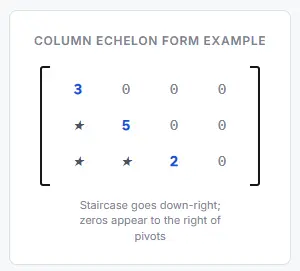
The term column echelon form is used less consistently than row echelon form.
A useful way to define it is through the transpose of a matrix.
A matrix AA is in column echelon form when:
ATA^T
is in row echelon form.
For example:
A=[100210341]A= \begin{bmatrix} 1&0&0\\ 2&1&0\\ 3&4&1 \end{bmatrix}
has columns that exhibit a corresponding staircase structure.
The important distinction is:
- Row echelon form organizes pivots across rows.
- Column echelon form applies the analogous idea to columns.
- Row operations naturally produce row echelon form.
- Column operations can be used to produce analogous column-based forms.
For most introductory linear algebra problems, when a question says “echelon form of a matrix,” it usually means row echelon form.
Echelon Form of a Matrix for 2 Marks
If you need a short examination answer, use this:
Echelon form of a matrix is a form in which all zero rows are at the bottom, each leading nonzero entry of a lower row lies to the right of the leading entry in the row above, and all entries below each leading entry are zero.
If your textbook requires leading 1s, you can add:
In some textbook conventions, every leading entry is required to be 1.
This is a good 2-mark definition of echelon form of a matrix because it states the core conditions without unnecessary explanation.
Echelon Form Definition in Simple Words
In simple words:
Echelon form means arranging a matrix like a staircase.
For example:
[1234015600170000]\begin{bmatrix} 1&2&3&4\\ 0&1&5&6\\ 0&0&1&7\\ 0&0&0&0 \end{bmatrix}
The important pattern is:
pivot→pivot→pivot\boxed{\text{pivot}} \rightarrow \boxed{\text{pivot}} \rightarrow \boxed{\text{pivot}}
as you move downward.
Why Is Echelon Form Important?
Echelon form is useful because it turns a complicated matrix into a simpler structure.
It can help you:
- solve systems of linear equations
- find the rank of a matrix
- identify pivot variables
- identify free variables
- determine whether equations are dependent
- detect inconsistent systems
- perform Gaussian elimination
- simplify matrix calculations
- understand linear independence
- support numerical algorithms
The method is especially important because the same row operations used to simplify a matrix can be interpreted as equivalent transformations of a system of equations.
Gaussian Elimination Workflow
The complete process can be viewed as:
Input Matrix
     |
     v
Find Pivot
     |
     v
Swap Rows if Needed
     |
     v
Normalize Pivot if Required
     |
     v
Eliminate Entries Below Pivot
     |
     v
Move to Next Pivot
     |
     v
Repeat
     |
     v
Row Echelon Form
     |
     +------------------+
     |                  |
     v                  v
Back Substitution    Continue Reduction
     |                  |
     v                  v
Solution             RREF
This workflow is the basic algorithmic structure behind Gaussian elimination.
Gaussian Elimination Algorithm
A simplified version of the algorithm is:
Input: Matrix A

1. Start with the first column.
2. Find a nonzero pivot.
3. Swap rows if necessary.
4. Use the pivot to make entries below it zero.
5. Move to the next column and remaining rows.
6. Find the next pivot.
7. Repeat elimination.
8. Move zero rows to the bottom.
9. Return the echelon form.
A mathematical implementation typically keeps track of:
- pivot row
- pivot column
- elimination factor
- row swaps
- numerical precision
Pseudocode for Echelon Form
function gaussian_elimination(A):

    row = 0

    for column in columns(A):

        find a suitable pivot in or below row

        if no pivot exists:
            continue

        swap pivot row with current row

        optionally scale pivot row

        for each row below current row:
            eliminate the value in pivot column

        row = row + 1

        if row reaches the last row:
            stop

    return A
This basic structure can be implemented in Python, Java, C++, MATLAB, R, or other programming languages.
Python Example
You can calculate row echelon form using symbolic mathematics with SymPy.
import sympy as sp

A = sp.Matrix([
    [1, 2, 3],
    [2, 5, 8],
    [3, 8, 13]
])

echelon = A.echelon_form()

print(echelon)
For reduced row echelon form:
rref_matrix, pivots = A.rref()

print(rref_matrix)
print(pivots)
The pivots result identifies the pivot columns.
NumPy Example
For numerical work, NumPy can be used to implement Gaussian elimination manually.
import numpy as np

A = np.array([
    [2.0, 4.0, 6.0],
    [4.0, 9.0, 13.0],
    [2.0, 5.0, 9.0]
])

rows, cols = A.shape

for i in range(min(rows, cols)):
    pivot = A[i, i]

    if abs(pivot) < 1e-12:
        continue

    for j in range(i + 1, rows):
        factor = A[j, i] / pivot
        A[j] = A[j] - factor * A[i]

print(A)
This demonstrates the elimination concept.
For production numerical computing, however, numerical linear algebra libraries generally use more sophisticated algorithms and pivoting strategies rather than relying on a minimal educational implementation.
Partial Pivoting and Numerical Stability
For exact symbolic mathematics, simple Gaussian elimination can be straightforward.
For floating-point numerical calculations, the choice of pivot can matter.
Suppose a pivot is extremely small:
aii≈0a_{ii}\approx0
Dividing by a very small number can amplify numerical errors.
A common strategy is partial pivoting.
Instead of automatically using the current diagonal element, the algorithm searches the current column for a suitable entry with a large absolute value and swaps that row into the pivot position.
Conceptually:
Current column

| 0.000001 |
| 4.52     |  <-- better pivot
| 1.73     |
The algorithm can swap the rows so that 4.52 becomes the pivot.
This is an important distinction between understanding Gaussian elimination mathematically and implementing it robustly for floating-point computation.
Computational Complexity
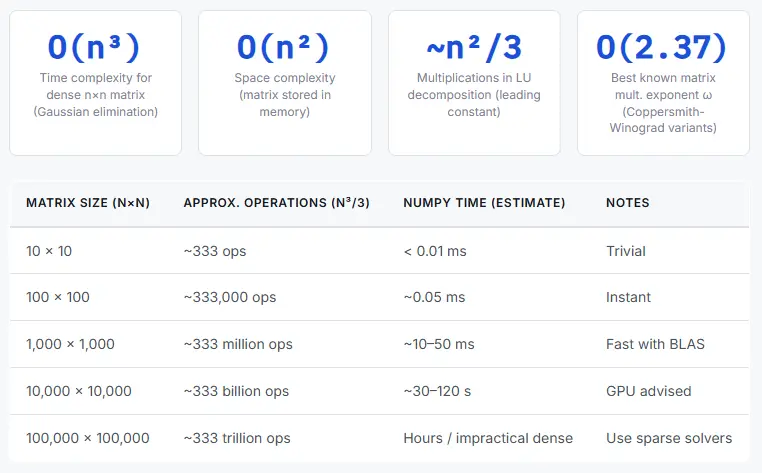
For a dense n×nn\times n matrix, standard Gaussian elimination has approximately:
O(n3)\boxed{O(n^3)}
time complexity.
Its memory requirement is typically:
O(n2)\boxed{O(n^2)}
for storing a dense matrix.
The exact runtime depends on factors such as:
- matrix dimensions
- sparsity
- numerical data type
- hardware
- implementation
- pivoting
- memory access patterns
- optimized linear algebra libraries
Therefore, it is better to describe the complexity theoretically rather than claim a particular runtime without a controlled benchmark.
Benchmarking Gaussian Elimination
If you are comparing implementations, a meaningful benchmark should specify:
| Benchmark factor | Example |
|---|---|
| Matrix size | 100 × 100 |
| Matrix type | Dense |
| Data type | Float64 |
| Algorithm | Gaussian elimination |
| Pivoting | Partial pivoting |
| Hardware | CPU model |
| Software | Python/NumPy/SciPy |
| Runs | Multiple repetitions |
| Metric | Median execution time |
| Accuracy | Residual/error check |
A benchmark without these details can be misleading because matrix size, hardware, implementation, and numerical method can significantly affect the result.
Real-World Applications of Echelon Form
Echelon form is not limited to classroom matrix exercises.
1. Engineering
Engineers use systems of linear equations to model relationships among:
- forces
- currents
- voltages
- measurements
- physical constraints
Matrix reduction can simplify these systems.
2. Computer Science
Linear algebra appears in:
- computer graphics
- robotics
- optimization
- numerical computing
- scientific programming
Echelon forms are part of the broader toolkit used to analyze linear systems.
3. Data Science
Data analysis frequently involves matrices representing observations and variables.
Rank and linear dependence can help identify whether variables contain redundant information.
4. Machine Learning
Machine learning relies heavily on linear algebra.
Matrices and vector spaces appear in:
- linear regression
- optimization
- dimensionality reduction
- neural-network computations
- feature representations
In production machine-learning systems, specialized numerical algorithms are often preferred for stability and performance, but the concepts of rank, pivots, linear independence, and matrix structure remain fundamental.
5. Computer Graphics
Transformations of points and objects can be represented using matrices.
Linear systems also arise in geometric calculations, transformations, and reconstruction problems.
Common Mistakes in Echelon Form
Mistake 1: Putting a zero row above a nonzero row
Incorrect:
[000123]\begin{bmatrix} 0&0&0\\ 1&2&3 \end{bmatrix}
Move the zero row to the bottom.
Mistake 2: Allowing a lower pivot to move left
Incorrect:
[123004025]\begin{bmatrix} 1&2&3\\ 0&0&4\\ 0&2&5 \end{bmatrix}
The third-row pivot is left of the second-row pivot.
Mistake 3: Confusing REF with RREF
This matrix can be REF:
[1201]\begin{bmatrix} 1&2\\ 0&1 \end{bmatrix}
but it is not RREF because the entry above the second pivot is not zero.
Mistake 4: Assuming every REF pivot must be 1
This depends on the definition being used.
Under the general definition:
[2304]\begin{bmatrix} 2&3\\ 0&4 \end{bmatrix}
can be row echelon form.
Some textbooks require leading 1s, so always follow the convention used in your course.
Mistake 5: Performing an invalid row operation
For example, multiplying only one entry of a row instead of the entire row changes the matrix incorrectly.
A row operation must apply consistently to the complete row.
Echelon Form vs Triangular Form
These concepts are related but should not be treated as identical.
A square upper triangular matrix looks like:
[abc0de00f]\begin{bmatrix} a&b&c\\ 0&d&e\\ 0&0&f \end{bmatrix}
A row echelon matrix has a broader definition based on the positions of leading entries and zero rows.
An echelon matrix can be rectangular and can have its first pivot in a column other than the first.
For example:
[014500270000]\begin{bmatrix} 0&1&4&5\\ 0&0&2&7\\ 0&0&0&0 \end{bmatrix}
is naturally described as row echelon form even though it is not a conventional upper triangular square matrix.
Does Every Matrix Have an Echelon Form?
Yes.
Every matrix can be transformed into row echelon form using a sequence of elementary row operations.
For example:
A=[24612]A= \begin{bmatrix} 2&4\\ 6&12 \end{bmatrix}
Apply:
R2→R2−3R1R_2\rightarrow R_2-3R_1
giving:
[2400]\begin{bmatrix} 2&4\\ 0&0 \end{bmatrix}
The result is in echelon form.
Is Echelon Form Unique?
Ordinary row echelon form is generally not unique.
For example, different valid row operations can produce different echelon matrices.
However, the reduced row echelon form is unique for a given matrix.
This distinction is important.
REF
Potentially multiple valid forms.
RREF
Exactly one reduced row echelon form for a matrix.
Echelon Form and Linear Independence
The number of pivots can tell us about linear independence.
If a matrix has a pivot in every column, its columns are linearly independent.
If one or more columns do not contain pivots, those columns can be expressed in terms of pivot columns in the appropriate setting.
Thus, reducing a matrix to echelon form provides structural information about the original matrix.
Echelon Form of a Rectangular Matrix
Echelon form does not require a square matrix.
For example:
[123450123400156]\begin{bmatrix} 1&2&3&4&5\\ 0&1&2&3&4\\ 0&0&1&5&6 \end{bmatrix}
is a 3×53\times5 matrix in echelon form.
It has:
- 3 rows
- 5 columns
- 3 pivots
- 2 non-pivot columns
A matrix with more columns than rows can therefore have free variables when used as the coefficient matrix of a system.
More Rows Than Columns
Consider:
[12010000]\begin{bmatrix} 1&2\\ 0&1\\ 0&0\\ 0&0 \end{bmatrix}
This is a 4×24\times2 matrix.
The number of pivots cannot exceed the smaller of the number of rows and columns.
Therefore:
rank(A)≤min(m,n)\operatorname{rank}(A)\leq\min(m,n)
for an m×nm\times n matrix.
All-Zero Matrix
Consider:
A=[000000000]A= \begin{bmatrix} 0&0&0\\ 0&0&0\\ 0&0&0 \end{bmatrix}
This matrix is already in echelon form.
There are no nonzero rows, so there are no pivots.
Therefore:
rank(A)=0\operatorname{rank}(A)=0
One Nonzero Row
Consider:
A=[003500000000]A= \begin{bmatrix} 0&0&3&5\\ 0&0&0&0\\ 0&0&0&0 \end{bmatrix}
This is in echelon form.
The first nonzero entry is 3 in column 3.
The remaining rows are zero rows and appear below it.
The rank is:
1\boxed{1}
Echelon Form of an Augmented Matrix
When solving a system of equations, we often work with an augmented matrix.
For:
x+2y=53x+4y=11\begin{aligned} x+2y&=5\\ 3x+4y&=11 \end{aligned}
the augmented matrix is:
[1253411]\left[ \begin{array}{cc|c} 1&2&5\\ 3&4&11 \end{array} \right]
After elimination:
[1250−2−4]\left[ \begin{array}{cc|c} 1&2&5\\ 0&-2&-4 \end{array} \right]
This is an echelon form.
The vertical line separates the coefficient matrix from the constants.
Echelon Form and Solution Types
Echelon form can help classify a linear system.
| Echelon pattern | Meaning |
|---|---|
| Pivot in every variable column | No free variables |
| Fewer pivots than variables | Free variables exist |
| Row 0=nonzero0=nonzero | No solution |
| Consistent system with free variables | Infinitely many solutions |
| Pivot for every variable and no contradiction | Unique solution |
For example:
[000∣5][0\quad0\quad0\mid5]
means:
0=50=5
which is impossible.
Therefore, the system is inconsistent.
A Practical Decision Table
| Your goal | Form or method |
|---|---|
| Understand matrix structure | Echelon form |
| Solve a system | Gaussian elimination |
| Perform back-substitution | REF |
| Get zeros above and below pivots | RREF |
| Find rank | Count pivots |
| Find pivot columns | Identify leading entries |
| Identify free variables | Find non-pivot columns |
| Get a unique canonical reduced form | RREF |
| Analyze numerical systems | Gaussian elimination with appropriate pivoting |
Echelon Form: Key Terminology
Understanding these terms makes matrix problems much easier.
Leading entry
The first nonzero entry in a nonzero row.
Pivot
A leading entry used to eliminate entries in other rows.
Pivot column
A column containing a pivot.
Free variable
A variable associated with a non-pivot column in a linear system.
Row operation
An operation that changes a matrix while preserving the relevant row-equivalence relationship.
Row echelon form
A staircase arrangement produced through row operations.
Reduced row echelon form
A further-reduced form in which pivot entries are 1 and are the only nonzero entries in their columns.
Gaussian elimination
A systematic procedure for producing echelon form.
Gauss-Jordan elimination
A continuation of elimination that produces reduced row echelon form.
Echelon Form vs Gaussian Elimination
These terms describe different things.
Echelon form is the resulting matrix structure.
Gaussian elimination is the process used to obtain that structure.
Think of it this way:
Gaussian Elimination
        |
        v
Row Operations
        |
        v
Pivot Selection
        |
        v
Zero Entries Below Pivots
        |
        v
Echelon Form
So, if a question asks:
What is echelon form?
It is asking about the form of the matrix.
If it asks:
What is the echelon method?
It is asking about the procedure used to reach that form.
Frequently Asked Questions About Echelon Form
What is echelon form of a matrix?
Echelon form is a staircase arrangement of a matrix in which zero rows are at the bottom, lower leading entries move to the right, and entries below leading entries are zero.
What is echelon form of matrix?
Echelon form of a matrix is another way of referring to row echelon form, the standard staircase form obtained through row operations.
What is the definition of echelon form?
A matrix is in echelon form when its nonzero rows form a staircase pattern, zero rows are at the bottom, and entries below each leading entry are zero.
What is an echelon matrix?
An echelon matrix is a matrix arranged according to the conditions of row echelon form.
What is a matrix in echelon form?
A matrix is in echelon form when each lower row begins farther to the right than the row above it and all entries below the leading entries are zero.
What does echelon form mean?
It means that the matrix has been arranged into a staircase-like structure based on the locations of its leading entries.
Define echelon form of a matrix with example.
An echelon form matrix has zero rows at the bottom, progressively right-shifted leading entries, and zeros below each leading entry.
Example:
[123014005]\begin{bmatrix} 1&2&3\\ 0&1&4\\ 0&0&5 \end{bmatrix}
Define echelon form of a matrix for 2 marks.
Echelon form is a matrix form in which all zero rows are at the bottom, each lower row’s leading entry lies to the right of the leading entry above it, and all entries below leading entries are zero.
Define row echelon form.
Row echelon form is a staircase matrix form where nonzero rows occur above zero rows and each row’s leading entry is farther right than the leading entry in the row above.
What is echelon form in matrices?
It is a simplified matrix arrangement that makes pivots, rank, and solutions of linear systems easier to identify.
What is echelon form of a matrix example?
One example is:
[123045006]\begin{bmatrix} 1&2&3\\ 0&4&5\\ 0&0&6 \end{bmatrix}
The pivots move from left to right, and all entries below them are zero.
What is the echelon method in matrices?
The echelon method uses elementary row operations to transform a matrix into row echelon form. Gaussian elimination is the standard procedure.
What is column echelon form?
Column echelon form is the analogous staircase concept applied to columns. It can be described through the transpose: AA has the corresponding column-echelon structure when ATA^T has row echelon form.
Is echelon form the same as reduced echelon form?
No.
Echelon form requires the staircase structure, while reduced row echelon form additionally requires each pivot to be 1 and the only nonzero entry in its column.
Is every RREF matrix also in echelon form?
Yes.
Every reduced row echelon matrix satisfies the conditions of row echelon form.
Is every echelon matrix in RREF?
No.
An echelon matrix can contain nonzero entries above pivots or pivots that are not normalized to 1, depending on the convention.
Is echelon form unique?
Generally, no. Different valid row operations can produce different row echelon forms. RREF, however, is unique.
Can a zero matrix be in echelon form?
Yes.
A zero matrix is already in echelon form because it has no nonzero rows.
Can an echelon matrix be rectangular?
Yes.
Echelon form applies to rectangular matrices as well as square matrices.
What is the echelon form of a 2 × 2 matrix?
A typical example is:
[1203]\begin{bmatrix} 1&2\\ 0&3 \end{bmatrix}
assuming the applicable convention permits the second pivot to be 3 rather than requiring it to be 1.
What is the difference between echelon and reduced echelon form?
The key difference is that RREF eliminates entries both above and below each pivot and uses normalized pivot values of 1.
Why is echelon form important?
It makes systems of equations easier to solve and provides information about rank, pivots, free variables, and linear dependence.
What is the rank of a matrix in echelon form?
The rank equals the number of nonzero rows, equivalently the number of pivots, in an echelon form obtained by row reduction.
How do you find echelon form?
Use elementary row operations, choose pivots from left to right, eliminate entries below each pivot, and place zero rows at the bottom.
What is Gaussian elimination?
Gaussian elimination is an algorithm that uses elementary row operations to transform a matrix into row echelon form.
What is Gauss-Jordan elimination?
Gauss-Jordan elimination continues the elimination process until the matrix reaches reduced row echelon form.
What are the three elementary row operations?
They are:
- interchange two rows
- multiply a row by a nonzero constant
- add a multiple of one row to another row
What is the easiest way to remember echelon form?
Remember:
Zero rows down, pivots right, zeros below.
If your textbook requires leading 1s, add:
Make each pivot 1.
Echelon Form: Quick Summary
The most important points are:
- Echelon form describes a staircase arrangement of a matrix.
- It is usually referring to row echelon form.
- Zero rows must appear at the bottom.
- Each lower leading entry must occur farther right than the leading entry above it.
- Entries below leading entries must be zero.
- Some textbooks require leading entries to be 1, while others do not.
- Gaussian elimination is the standard method used to obtain echelon form.
- Reduced row echelon form goes one step further by making each pivot 1 and eliminating entries above and below each pivot.
- The number of pivots gives the matrix rank.
- Non-pivot columns can correspond to free variables in a system.
- Echelon form is widely used for solving systems of linear equations and studying matrix structure.
The easiest definition to remember
Echelon form = staircase structure + zero rows at bottom + zeros below pivots\boxed{ \text{Echelon form = staircase structure + zero rows at bottom + zeros below pivots} }
Once you understand the staircase pattern, pivot positions, and elementary row operations, most basic echelon-form problems become much easier.

AiVoogle – AI Tutorials & AI Tools
AiVoogle is an AI-focused platform sharing practical AI tutorials, AI tools, guides, reviews, and the latest trends in artificial intelligence. Our goal is to make AI simple, useful, and accessible for everyone—from beginners and creators to marketers, developers, and businesses.
The AiVoogle team researches and covers the latest AI tools and technologies to help readers discover the right tools and learn how to use AI effectively.
Focus: AI Tutorials | AI Tools | AI Guides | AI News | AI Reviews