
For years, business techniques have utilized automation in order to improve efficiency, decrease labor time, and standardize processes. Classical automation systems helped businesses execute transactions, control business activities, and conduct monotonous tasks very quickly and precisely.
However, with the advent of AI agents, new possibilities arise in terms of automation applications. Rather than just conducting actions prescribed for them earlier, AI agents can analyze the information, make their own decisions, and perform complicated work independently.
As a result, there arises a question for business leaders: what approach should they choose, whether to stick to traditional automation or switch to AI agents?
This question can be solved only after defining what processes the organization plans to optimize. While AI agents apply certain innovations, traditional automation is more effective for a great number of standard processes with little variability.
How deterministic automation differs from agentic workflows
The primary distinction between traditional automation technologies and artificial intelligence agents is in the way tasks are executed. Traditional automation means sticking to the prescribed algorithm. It always follows the pre-set conditions to carry out a particular action after a specific conditional requirement is fulfilled.
For instance, the steps of an automated invoice processing system can include:
- Receiving an invoice
- Extracting the necessary data
- Verifying the required information
- Submitting for approval
- Updating the accounting program
The system does not have its own judgment abilities, so it applies the deterministic framework prepared by developers or business analysts.
This way of doing things is effective only under reliable working conditions when all the outcomes can be anticipated since all the possible scenarios are already in place.
Technology designed to work through defining goals distinguishes AI agents from the traditional approach. Instead of being limited to an algorithm and following it, agents look at their surroundings and tools to fulfill the task. Businesses often work with an AI assisted development partner to identify suitable use cases and integrate these agent-based workflows into existing systems.
An AI sales assistant can be instructed to look for desirable leads. It can use CRM data, check previous dealings, analyze customer behavior, and create suggestions. The exact steps can differ due to constantly changing information.
Such workflows are useful whenever there are things that are not fixed but instead change with time or involve information from many sources.
Tasks where AI reasoning adds real value
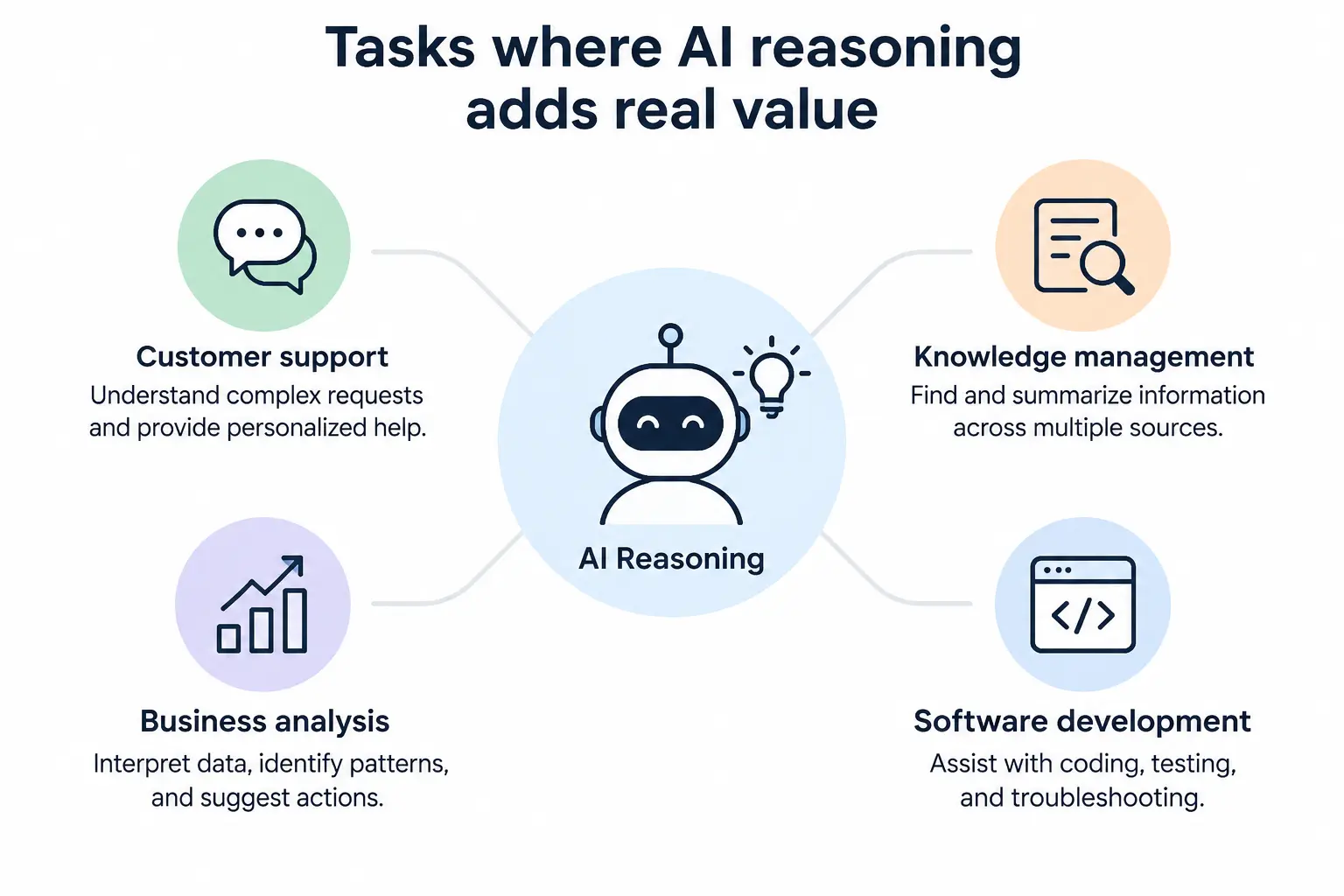
AI agents should not be seen as something that will replace all automation systems on the market. Their greatest strength is unlocking the potential for reasoning and understanding in situations.
Customer service and support
Traditional chatbots tend to have a limited number of responses that can be fit into predetermined templates. They provide effective service in cases of frequently asked questions but become less helpful when a client’s request is too complicated.
AI agents are able to figure out the real intent of the client’s request and access the necessary data for effective assistance.
In particular, an AI agent could:
- Analyze the nature of a customer complaint
- Check the history of the customer’s account
- Search for relevant documents on file
- Generate solutions
- Initiate escalation procedures when necessary
This enables companies with complex processes to keep their response times short.
Knowledge management
Many companies collect relevant information in several documents, databases and communications. Employees are required to spend considerable amounts of time searching for it.
AI agents assist in knowledge management as they utilize multiple data sources and provide valuable answers.
These include:
- Aiding employees in locating company regulations
- Summarizing technical documents
- Fulfilling onboarding procedures
- Making research easier for teams
Business analysis and decision support
Traditional computing allows generating reports using historical data and statistics. But the use of AI agents is achieving more because they provide analysis of the data and possible actions.
So, for instance, an AI agent may analyze sales performance and determine the reduced level of customer engagement, finding the causes of the process and suggesting further steps.
Software development and IT operations
AI applications are used more and more in order to assist engineers in:
- Code analysis
- Documenting
- Testing
- Troubleshooting
- Technical research
But human experts still play an important part in this process.
When traditional automation remains more reliable
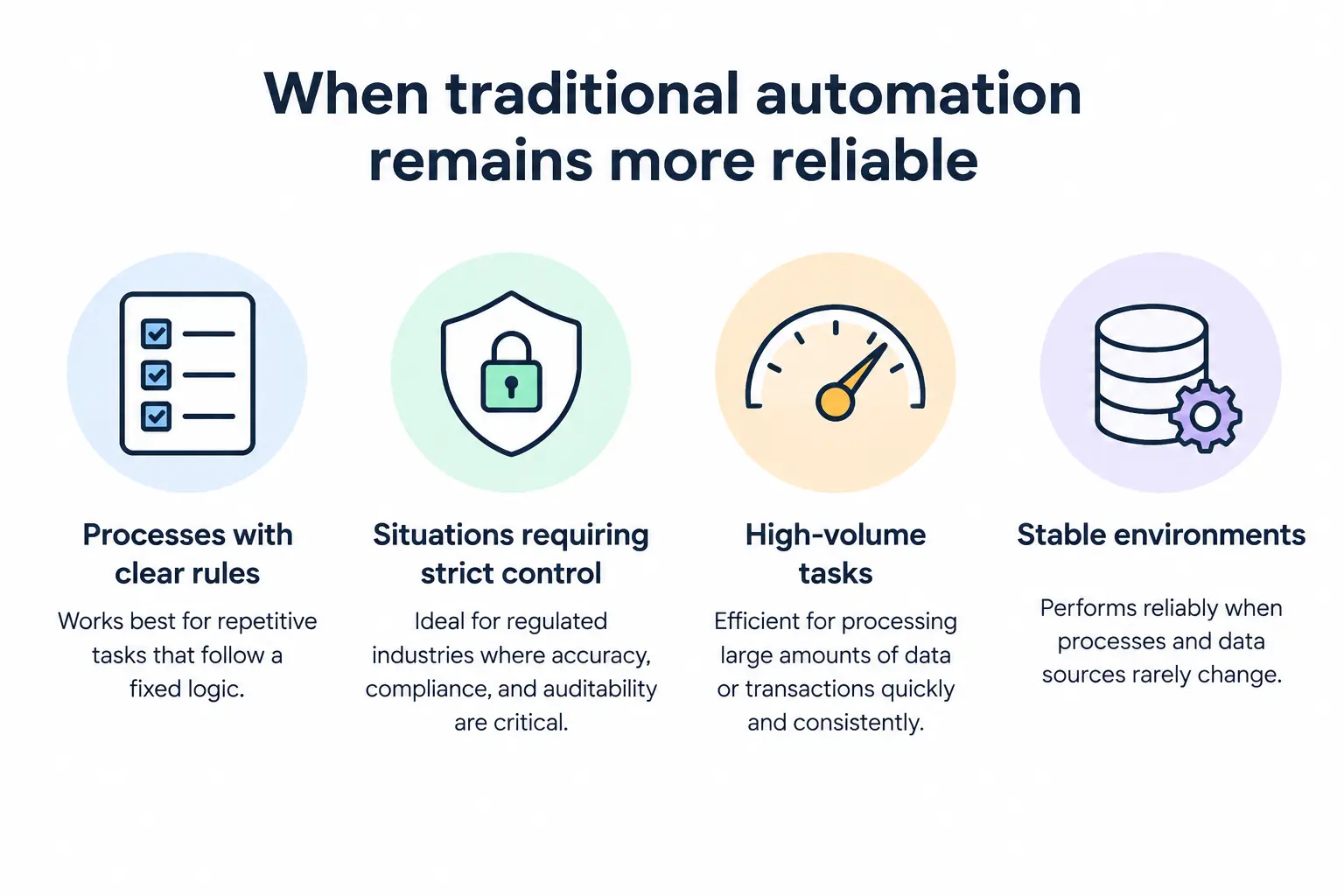
Regardless of the focus on artificial intelligence systems in business, automatic processing is still the best option for many processes.
Processes with clear rules
When it is easy to predict the sequence of actions to be taken, applying rule automation works more efficiently.
Some examples include:
- Payroll calculation
- Data synchronization across information systems
- Scheduled notification
- Compliance reports
- Order processing
Processes like these involve no need for interpretation but rather consistency.
Situations requiring strict control
Some sectors need an environment that is as predictable as possible to avoid dangers connected with mistakes.
Financial sectors, the healthcare industry, and regulated sectors apply traditional automation for essential work processes, as it allows tracking each single move.
High-volume repetitive tasks
In case a company needs to do the same job many times, it is better not to use artificial intelligence.
As an example, updating customer records or transferring data from one program to another is something that does not require a well-developed system.
Cost, security, and maintenance trade-offs
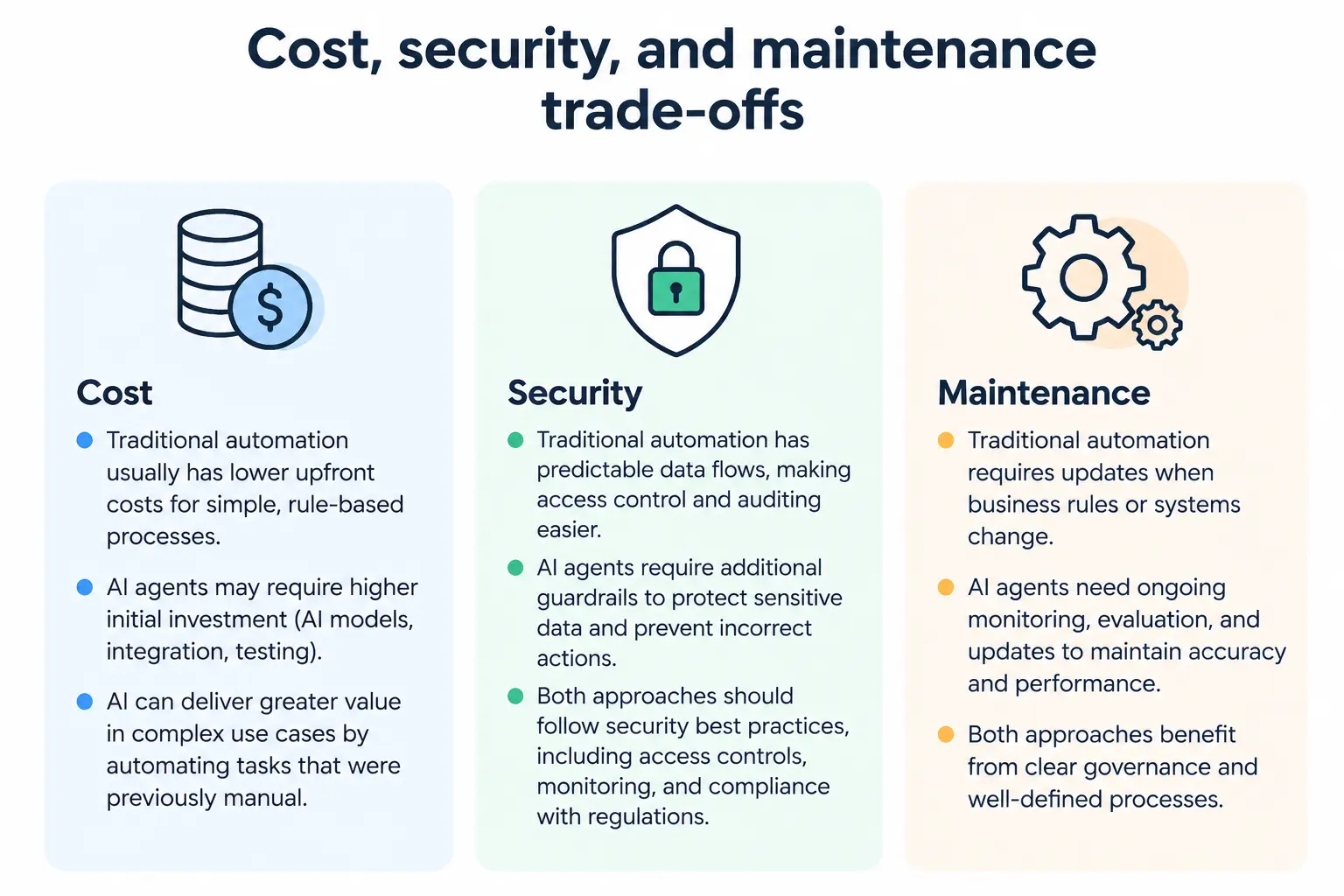
Assessing the pros and cons of AI agents as opposed to conventional automation needs more than just consideration of an organization’s technical requirements.
Cost issues
Generally speaking, when the process is uncomplicated and clearly defined, traditional automation is less costly to implement. Besides, once these systems are deployed, they usually require little maintenance.
AI agents may need more investment, given the following aspects:
- AI modeling
- Preparing data
- Testing and evaluation
- Monitoring procedures
- Governance issues
The willingness to incur costs required for the implementation of the AI agents in the organization can be justified because they add value in terms of eliminating complex manual processes or enabling the performance of hard-to-automate tasks.
Security considerations
Both methods necessitate thoughtful security arrangements.
Traditional automation usually implies known data mixes, which simplifies both implementing access limitations and conducting evaluations.
However, utilizing AI agents implies several additional issues as follows:
- Sealing off sensitive information used by AI orchestration,
- Managing entry to connected systems,
- Avoiding misuse of their functions,
- Supervising the results produced by AI.
Organizations using AI systems must implement some precautionary measures such as limiting access to information, creating activity logs, and inventing procedures for human decision-making concerning important issues.
Maintenance requirements
Traditional automation needs to be modified whenever business rules or systems are changed. Updates usually do not raise difficulties since there are predefined workflows.
AI agents need regular monitoring to produce correct output. The organization might be obliged to monitor its performance, review information sources, and modify the instructions.
How businesses can choose the right approach
A company’s decisions must be based on business objectives rather than specific technology.
The questions to ask are:
- Do the processes run themselves or do you need to make decisions for them?
- Are there many exceptions?
- Is the process analysis based on unstructured data?
- Is accuracy more substantial than flexibility?
- Will decisions supported by AI lead to better outcome?
In some cases, it may be reasonable to combine the strengths of both technologies.
An AI-based system may be used to analyze the customer’s request and make relevant decisions, while traditional automation will implement the relevant processes.
Final thoughts
In conclusion, AI and traditional automation tackle different issues in business operations. Traditional automation is still very effective for situations requiring structured and repetitive tasks. AI is advantageous when companies are looking for methods to interpret and analyze events and facilitate decision-making. For most organizations, the future will not involve a choice between the use of automation and AI. Rather, it will entail creating intelligent business processes in which both technologies fulfill the functions that they do most effectively.

Yuliya Melnik is a technology writer specializing in AI, automation, and digital transformation. She covers how emerging technologies help businesses improve processes, increase efficiency, and adopt smarter digital solutions.