

Introduction
AI vs machine learning is not really a competition between two separate technologies. Machine learning is one of the major technical approaches used to build AI systems.
That distinction matters when you are deciding what technology your company actually needs. A recommendation engine, fraud detector, forecasting model, AI assistant, and autonomous workflow may all use AI, but they can rely on very different architectures.
If you are evaluating an AI project, the useful question is not simply “Should we use AI or ML?” The better question is: What capability are we trying to build, what data do we have, and what level of autonomy does the system need?
What Is Artificial Intelligence?
Artificial intelligence is the broader field of building computer systems that can perform tasks involving capabilities such as perception, reasoning, planning, prediction, decision-making, communication, learning, or action.
NIST’s current terminology is deliberately broader than the popular definition of AI. It includes systems that make predictions, recommendations, or decisions based on human-defined objectives, while other definitions emphasize human-like cognition or autonomous action.
That means AI does not necessarily mean a neural network or a model trained on millions of examples.
An AI system can use:
- Machine learning
- Deep learning
- Knowledge representation
- Search algorithms
- Optimization
- Rules and logic
- Planning
- Natural language processing
- Computer vision
- Robotics
- AI agents
The practical takeaway is simple:
AI describes the broader capability or field. It does not describe one specific algorithm.
Example: An AI customer-support system
Consider an enterprise support platform.
It could classify an incoming request using machine learning, retrieve information from a knowledge base, apply business rules, generate a response using a language model, and escalate certain cases to a human.
The complete application is an AI system.
Only some of its components may be machine learning models.
Key Takeaway
When someone says “we are building AI,” ask what capability the system must deliver. “AI” alone is too broad to determine the architecture.
What Is Machine Learning?
Machine learning is a branch of AI focused on systems that learn patterns from data and use those patterns to make predictions, classifications, recommendations, or decisions.
NIST defines machine learning around computer systems that adapt and learn from data with the goal of improving accuracy. In practical engineering terms, you provide training data, select an appropriate learning approach, train a model, evaluate it, and use the resulting model against new data.
Common machine learning approaches include:
- Supervised learning
- Unsupervised learning
- Semi-supervised learning
- Self-supervised learning
- Reinforcement learning
Examples include:
- Predicting customer churn
- Detecting fraudulent transactions
- Ranking search results
- Forecasting demand
- Recommending products
- Classifying documents
- Detecting anomalies
- Predicting equipment failures
The important distinction is that machine learning is a method for building systems that learn from data.
Why data quality matters
A sophisticated ML algorithm cannot compensate for fundamentally poor training data.
For an enterprise ML project, you should evaluate:
- Data availability
- Data quality
- Label quality
- Representativeness
- Data freshness
- Privacy requirements
- Distribution changes
- Model evaluation criteria
This is why many ML projects are data-engineering projects before they become model-engineering projects.
Key Takeaway
If your business problem can be expressed as a prediction, classification, ranking, recommendation, or similar data-driven task, machine learning may be an appropriate component.
AI vs Machine Learning: The Core Difference
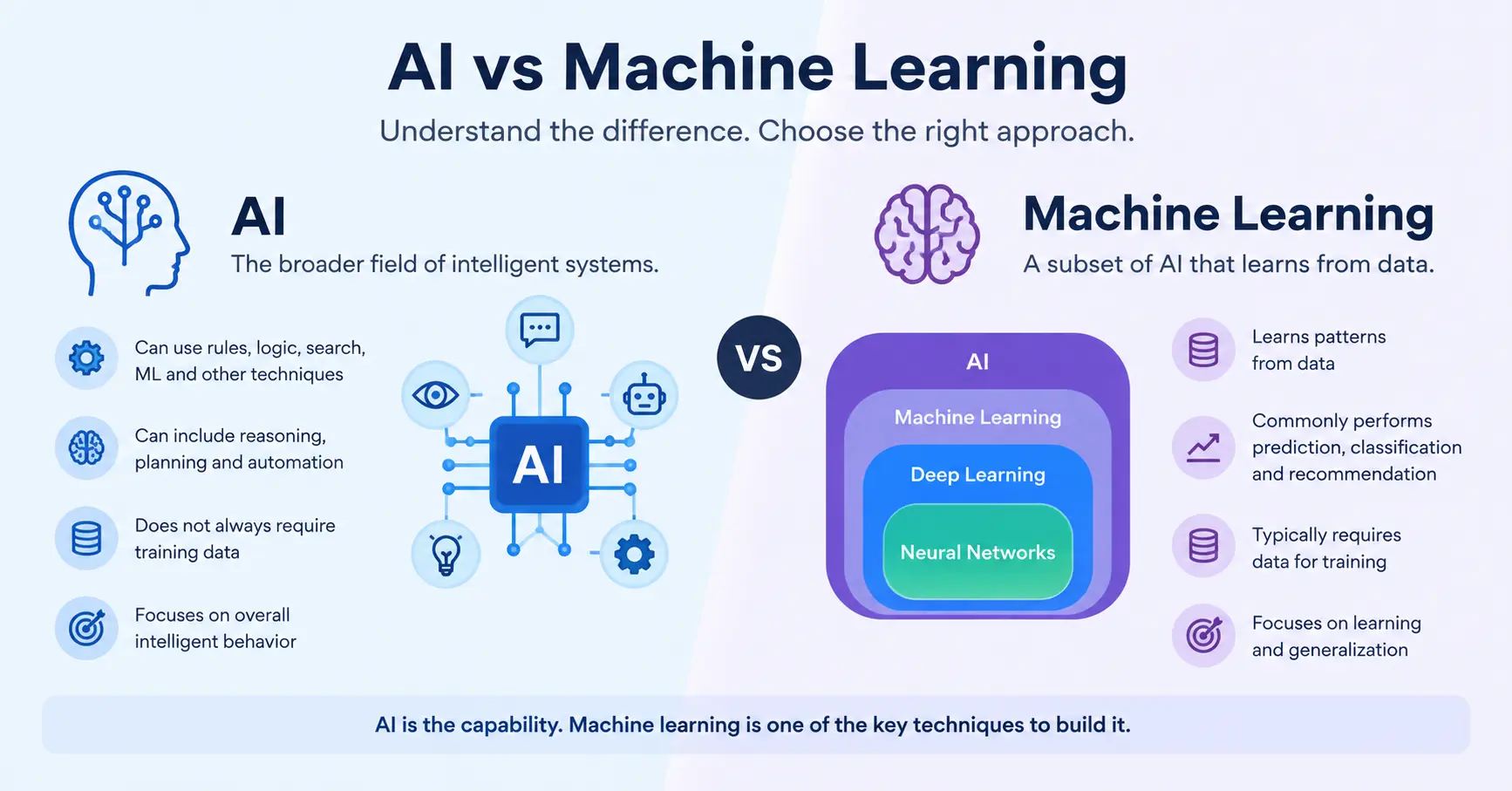
The simplest relationship is:
AI is the broader field. Machine learning is a subset of AI.
Think about it as a hierarchy:
Artificial Intelligence
→ Machine Learning
→ Deep Learning
→ Neural Network architectures
However, this hierarchy describes relationships between fields and techniques, not necessarily the architecture of every production AI application.
| Factor | Artificial Intelligence | Machine Learning |
|---|---|---|
| Scope | Broad field | Subfield of AI |
| Primary objective | Build systems capable of intelligent behavior | Learn patterns from data |
| Requires training data? | Not always | Usually yes |
| Can use rules? | Yes | Some ML systems can incorporate rules, but learning itself is data-driven |
| Prediction | Possible | Core use case |
| Reasoning/planning | Possible | Usually task-specific unless combined with other components |
| Automation | Common | Common |
| Examples | AI agents, robotics, expert systems, intelligent assistants | Fraud detection, recommendations, forecasting |
| Main engineering concern | Overall system capability | Data, model quality and generalization |
The mistake to avoid is treating AI and ML as competing alternatives.
ML can be the engine inside an AI application.
AI vs ML vs Deep Learning
Deep learning adds another layer to the relationship.
AI → Machine Learning → Deep Learning
Deep learning is a specialized area of machine learning that uses multi-layer neural networks to learn complex representations from data.
That makes the terminology easier to understand:
- AI: The broad field
- ML: Learning patterns from data
- Deep learning: ML using deep neural-network architectures
- Generative AI: Systems that generate content such as text, images, audio, video, or code
Large language models are a modern example of systems built using deep learning techniques.
But do not assume every AI application needs deep learning.
A simple business classification problem may perform better operationally with a smaller, interpretable model than with a large neural network.
Key Takeaway
Use the smallest technology stack that can reliably solve the business problem. Complexity is not a success metric.
How AI and Machine Learning Work Together
Modern enterprise systems frequently combine multiple technologies rather than choosing between AI and ML.
For example, imagine an e-commerce company building an intelligent product-recommendation assistant.
The system could contain:
- Customer data
- A machine learning recommendation model
- A product database
- A retrieval system
- A language model
- Business rules
- An orchestration layer
- Monitoring and evaluation
- Human escalation
The ML model predicts which products are relevant.
The AI application combines that prediction with other components to produce an action or user-facing experience.
This distinction becomes especially important with agentic systems.
An AI agent may use an ML-trained language model, but the agent itself also requires tools, instructions, memory or state, orchestration, permissions, and evaluation.
Key Takeaway
Do not evaluate an AI product by asking which model it uses alone. Evaluate the entire system around the model.
AI vs Machine Learning: Technical Comparison

For a technical leader, the difference becomes clearer when you compare the engineering responsibilities.
| Area | AI System | ML System |
|---|---|---|
| Business objective | Intelligent task or workflow | Data-driven prediction or decision |
| Architecture | Often multi-component | Often model-centered |
| Data | Structured and/or unstructured | Usually central to development |
| Rules | May be important | Usually secondary to learned patterns |
| Models | May contain multiple models | Usually one or more trained models |
| Training | May or may not be required | Typically required |
| Evaluation | System-level outcomes | Model and business metrics |
| Monitoring | Workflow, safety, quality, latency | Accuracy, drift, latency, data quality |
| Deployment | Application, agent, service or device | Model/API/batch/edge deployment |
| Governance | System behavior and risk | Model, data and prediction risk |
The difference matters because your operational requirements change with the architecture.
A simple ML model may need monitoring for prediction quality and data drift.
An AI agent may also need monitoring for tool usage, unauthorized actions, incorrect retrieval, unsafe outputs, latency, cost, and escalation behavior.
Real-World Business Use Cases
AI and ML overlap heavily in business, but they solve different layers of a problem.
Fraud detection
Machine learning can identify patterns associated with potentially fraudulent transactions.
The wider AI system can combine those predictions with transaction rules, authentication workflows, customer history, and human review.
Recommendation systems
An ML model can estimate which products or content a user may prefer.
An AI application can then use those predictions to personalize the customer’s experience.
Customer support
ML can classify tickets, predict intent, or identify sentiment.
An AI support application can combine classification, retrieval, language generation, business rules, and human escalation.
Predictive maintenance
ML can estimate the probability of equipment failure based on sensor data.
An AI-enabled maintenance system can then trigger alerts, prioritize work orders, retrieve maintenance procedures, and support technicians.
Financial services
ML can support fraud detection, risk modeling, classification, and forecasting.
The larger AI system may combine those models with workflow automation, document processing, rules, and decision-support interfaces.
Key Takeaway
The business use case should determine the technology. Starting with “we need AI” before defining the operational problem is backwards.
When Should You Use AI or Machine Learning?
Do not make this decision from the technology label.
Start with the business requirement.
Use machine learning when:
- You have enough relevant data.
- The problem involves patterns or predictions.
- You can define measurable outcomes.
- Historical data is reasonably representative.
- Model performance can be evaluated.
- Predictions can improve a business process.
Examples include demand forecasting, churn prediction, fraud detection, and recommendation.
Use a broader AI architecture when:
- The system needs multiple capabilities.
- It must combine models with rules or tools.
- It needs language or multimodal interaction.
- It must plan or execute multiple steps.
- It interacts with external systems.
- The desired outcome is an intelligent workflow rather than a single prediction.
Do not use ML simply because:
- Your competitors are using it.
- You have a large dataset.
- A vendor calls its product “AI-powered.”
- A traditional rule can solve the problem more reliably.
- You cannot define how success will be measured.
Key Takeaway
If a deterministic rule solves the problem reliably, you may not need machine learning. If the problem requires learning patterns from changing data, ML becomes much more attractive.
AI and ML Enterprise Workflow
A useful enterprise workflow looks like this:
Business Problem
      ↓
Define Success Metric
      ↓
Assess Data + Constraints
      ↓
Choose Approach
      ↓
Rule-Based ────────┐
                   │
Machine Learning ──┼──→ System Architecture
                   │
Generative AI ─────┘
      ↓
Prototype
      ↓
Evaluate Against Baseline
      ↓
Security + Governance Review
      ↓
Production Deployment
      ↓
Monitor Quality, Cost, Risk
      ↓
Improve / Retrain / Replace
The important point is that model selection comes after problem definition.
For ML systems, production does not end when the model is deployed. MLOps practices cover activities such as experiment tracking, deployment, serving, monitoring, model management, and security. Google Cloud’s documented ML lifecycle also includes evaluation, validation, serving, and monitoring.
A practical enterprise example
Suppose you want to reduce customer churn.
Do not start by asking your team to “build an AI churn solution.”
Instead:
Business problem: Identify customers at high risk of leaving.
Baseline: Existing retention process.
ML candidate: Churn probability model.
Action layer: CRM workflow that prioritizes high-risk accounts.
Measurement: Retention rate, intervention rate, false positives, and business value.
Now you have a measurable ML use case inside a broader business system.
Common Mistakes When Choosing AI or ML
Treating AI and ML as synonyms
They are related but not interchangeable.
Calling every ML model “AI” may be acceptable in general marketing, but it becomes unhelpful when designing technical architecture.
Starting with the model
Choosing a model before defining the problem often creates unnecessary complexity.
Start with the outcome.
Ignoring the baseline
Your new system should beat something.
That something could be a manual process, existing software, a simple statistical model, or a rule-based system.
Without a baseline, “better AI” has no practical meaning.
Measuring model accuracy only
A model can perform well in testing and still fail to create business value.
Measure operational outcomes too.
Forgetting production monitoring
Data changes. User behavior changes. Products change. Business rules change.
An ML model that performed well during development can degrade after deployment. Production ML therefore requires ongoing monitoring and, where appropriate, retraining or replacement.
Key Takeaway
The production system matters more than the model benchmark.
A Practical AI/ML Decision Framework
Use this five-question framework before approving an AI or ML project.
1. What decision or task are you improving?
Write it as a measurable business outcome.
Bad:
“Build an AI solution.”
Better:
“Reduce the time required to classify inbound support requests.”
2. Is the problem deterministic?
If a clear rule handles most cases accurately, start there.
Do not introduce ML simply because it sounds more advanced.
3. Does historical data contain a useful signal?
If the desired prediction cannot be learned reliably from available data, ML may not be the right approach.
4. Does the system need generation, reasoning, retrieval, tools, or planning?
If yes, you may need an AI architecture that goes beyond a standalone predictive model.
5. How will you monitor it?
Define:
- Quality metrics
- Business metrics
- Latency
- Cost
- Data drift
- Failure modes
- Security risks
- Human escalation
Only then should you finalize the technical architecture.
The “Capability Before Technology” Rule
A useful prioritization model is:
Problem → Capability → Data → Architecture → Model → Deployment → Monitoring
Do not reverse this sequence.
Starting with “Which AI model should we use?” is often the wrong first question.
Future of AI and Machine Learning
The boundary between AI applications and ML infrastructure will continue to become less visible to end users.
From an engineering perspective, however, the distinction remains useful.
Modern AI systems increasingly combine:
- Foundation models
- Machine learning
- Retrieval
- Structured data
- Tool calling
- Workflow orchestration
- Agents
- Human oversight
- Evaluation systems
That means the future enterprise stack is unlikely to be “AI instead of ML.”
It is more likely to be AI systems composed of multiple specialized technologies, including ML.
The strategic challenge will shift from simply adopting models to operating intelligent systems reliably.
For technical leaders, that means paying closer attention to evaluation, governance, observability, security, data quality, model selection, and total cost of ownership.
Key Takeaway
The important question is no longer whether your company should “use AI.” It is where intelligent behavior creates measurable value and which technical approach can deliver it reliably.
FAQs
Is machine learning a type of AI?
Yes. Machine learning is generally considered a subset or branch of artificial intelligence. ML focuses on systems that learn patterns from data and use those patterns to make predictions, classifications, recommendations, or other decisions.
AI is broader. It can include machine learning as well as approaches involving rules, reasoning, planning, optimization, search, robotics, and other techniques.
Which is better, AI or machine learning?
Neither is inherently better because they describe different levels of technology.
AI is the broader field, while machine learning is one approach within AI. If you need a predictive model based on historical data, ML may be appropriate. If you need a complete intelligent workflow involving models, retrieval, tools, rules, and automation, you may need a broader AI architecture.
Is ChatGPT AI or machine learning?
ChatGPT is an AI application built using machine learning, particularly deep learning and large neural-network models.
Calling it simply “machine learning” misses the application layer. Calling it simply “AI” is accurate at a broad level, while machine learning describes a key technology used to build the underlying models.
Is deep learning the same as machine learning?
No.
Deep learning is a specialized area within machine learning. It uses multi-layer neural networks to learn complex patterns and representations.
The relationship can be simplified as:
AI → Machine Learning → Deep Learning
Does every AI system use machine learning?
No.
AI can be implemented using different techniques. Some systems can rely heavily on rules, search, optimization, planning, or symbolic reasoning. Many modern AI applications do use machine learning, but AI is not synonymous with ML.
Which requires more data, AI or machine learning?
There is no universal answer.
Machine learning typically depends heavily on data because the model learns patterns from data. The amount and type of data required depends on the learning method and task.
A broader AI system may combine ML with rules, external knowledge, tools, or deterministic logic and therefore may not depend entirely on training data for every component.
What is the difference between AI, ML, and generative AI?
AI is the broadest concept.
Machine learning is a major approach within AI that learns patterns from data.
Generative AI refers to AI systems designed to generate new content such as text, images, audio, video, or code. Many modern generative AI systems rely on machine learning and deep learning.
Conclusion
The biggest mistake in the AI vs machine learning discussion is treating them as competing technologies.
AI is the broader system or field. ML is one of the most important techniques used to create AI capabilities.
Three points should guide your technical decisions:
- Start with the business problem, not the model.
- Use ML when learning from data provides a measurable advantage.
- Design the complete AI system around reliability, evaluation, security, cost, and business outcomes.
Your next step should be to take one proposed AI initiative and write down its business outcome, baseline, available data, required capability, success metric, and production risks. That exercise will usually tell you whether you actually need machine learning, a broader AI architecture, or something much simpler.

AiVoogle – AI Tutorials & AI Tools
AiVoogle is an AI-focused platform sharing practical AI tutorials, AI tools, guides, reviews, and the latest trends in artificial intelligence. Our goal is to make AI simple, useful, and accessible for everyone—from beginners and creators to marketers, developers, and businesses.
The AiVoogle team researches and covers the latest AI tools and technologies to help readers discover the right tools and learn how to use AI effectively.
Focus: AI Tutorials | AI Tools | AI Guides | AI News | AI Reviews