
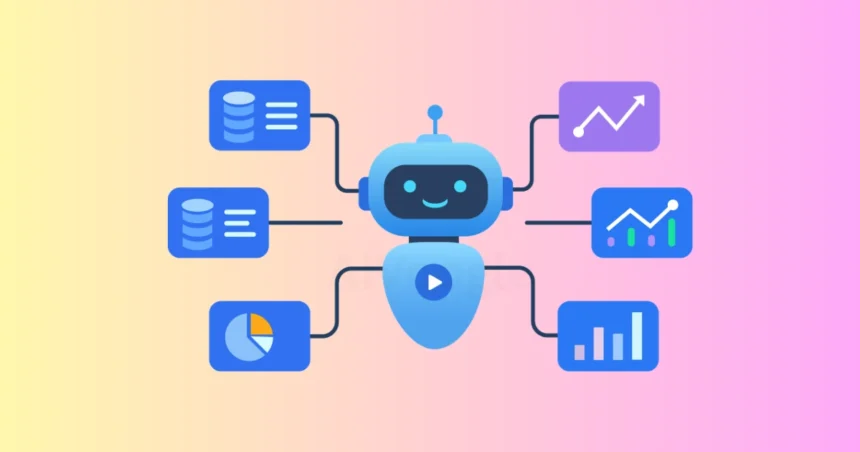
A multi-agent AI system is a setup where multiple specialized AI agents work together to complete tasks that are too complex, broad, or parallel for a single agent to handle well. Each agent has its own role, tools, memory, and instructions. A coordination layer decides who does what and how results are combined.
Think of it as a small team rather than one generalist. One agent might research, another write, a third check facts, and a fourth format the final output. The system only works when the agents can pass information cleanly and stay focused on their part of the job.
This approach has become practical because large language models can now follow role-specific instructions and use tools reliably. The value comes from specialization and parallel work, not from simply running more models.
How Multi-Agent Systems Differ from Single Agents
A single agent keeps everything in one context window. It plans, calls tools, and produces the answer in one continuous process. This is simpler, cheaper, and easier to debug.
A multi-agent system splits the work. Agents can run in parallel, use different models or tools, and maintain separate context. The cost is coordination overhead, higher token usage, and more points of failure.
The main practical differences are:
- Context isolation: each agent stays focused on a narrower task
- Parallelism: independent sub-tasks can run at the same time
- Specialization: different agents can use different prompts, models, or tool sets
- Complexity: handoffs, shared state, and error handling become necessary
Most teams should start with a strong single agent. Multi-agent designs only pay off when the work truly benefits from division.
Core Architecture Patterns
Four patterns dominate production systems in 2026.
Supervisor (Orchestrator-Worker) Pattern
A central supervisor agent receives the user request, breaks it into sub-tasks, assigns them to specialist workers, collects the results, and produces the final answer. This is the most common production pattern because it is easier to monitor and control.
It works well for research, document processing, and customer support workflows. The risk is that the supervisor becomes a bottleneck or a single point of failure.
Sequential (Pipeline) Pattern
Agents run in a fixed order. The output of one becomes the input of the next. This pattern is predictable and relatively cheap. It suits processes that have clear stages, such as intake → extraction → validation → formatting.
Errors can propagate forward, so validation steps between agents are important.
Hierarchical Pattern
Supervisors manage other supervisors in layers. This structure fits large, multi-domain workflows where different teams or security boundaries exist. Latency and cost rise with each layer, so it should be used only when the scale justifies it.
Peer-to-Peer or Swarm Pattern
Agents communicate directly without a strict central controller. This can produce flexible, emergent behavior but is harder to debug and govern. It is rarely the first choice for enterprise systems that need auditability.
Many real systems combine patterns. A supervisor might route work, while some workers run in parallel and a critic agent reviews the final output.
Key Components of a Multi-Agent System
Every working system needs these pieces:
- Individual agents with clear roles, system prompts, and tool access
- A coordination or orchestration layer that decides routing and sequencing
- Shared state or memory so agents can pass context without losing information
- Communication rules that define how results and failures are handed off
- Observability so you can see which agent did what and why
Without clear boundaries on tools and data access, agents can step on each other or leak information across security domains.
When to Use Multi-Agent Systems (and When Not To)
Use multi-agent architecture when at least one of these is true:
- The task breaks cleanly into independent sub-tasks that can run in parallel
- Different parts of the work need different tools, models, or expertise
- You need hard boundaries for security, compliance, or audit
- A single agent’s context window is consistently exceeded even after compression
Do not use multi-agent systems when:
- A single well-prompted agent with good tools already solves the problem
- The extra latency and cost outweigh the quality gain
- You cannot clearly define agent responsibilities
- Debugging and monitoring are still immature in your stack
The default in 2026 is still a single agent. Add agents only when measurement shows a clear benefit.
Real-World Use Cases
- Customer support : A triage agent classifies the issue and sentiment. A knowledge agent retrieves relevant policies and past tickets. A resolution agent drafts the reply and can trigger actions such as refunds or password resets. A supervisor escalates complex cases.
- Software engineering : One agent reviews style and conventions. Another scans for security issues. A third checks test coverage. A fourth looks at architecture. Results are merged into a single prioritized report.
- Research and analysis : A planner defines the research questions. Multiple retrieval agents pull from different sources in parallel. A synthesis agent combines findings. A critic checks citations and consistency.
- Document processing : An intake agent classifies documents. An extraction agent pulls structured fields. A validation agent flags anomalies. A compliance agent applies policy rules before the data is stored.
These patterns succeed when each agent has a narrow, well-defined job and the handoffs are explicit.
Common Challenges and Failure Modes
Multi-agent systems introduce new problems that single agents do not have.
Coordination overhead raises token cost. Anthropic and others have noted that multi-agent setups can use significantly more tokens than a single agent for the same task. Latency compounds at every handoff. Errors can cascade when one agent’s mistake becomes the next agent’s input. Debugging becomes harder because the failure can sit in any agent or in the orchestration logic.
Another frequent issue is role confusion. When agent instructions overlap, agents may duplicate work or argue. Clear, non-overlapping responsibilities and explicit handoff formats reduce this.
Shared state management is also critical. If agents cannot reliably read and write a common source of truth, context is lost and quality drops.
Frameworks and Tools in 2026
Several frameworks are widely used:
- LangGraph for stateful, controllable production workflows
- CrewAI for faster role-based prototypes
- AutoGen / AG2 for conversational agent teams
- OpenAI Agents SDK and Claude Agent SDK for simpler first-party handoffs
- Google ADK for hierarchical agent structures on Google Cloud
The right choice depends on how much control, observability, and state management you need. Many teams prototype in a higher-level framework and later move critical paths to more explicit graph-based orchestration.
Best Practices for Building Reliable Systems
Start with the smallest number of agents that can demonstrate value. Define each agent’s job, tools, and success criteria in writing before coding. Keep context isolation as a primary design goal. Log every handoff and decision so failures can be traced. Measure quality, cost, and latency against a single-agent baseline. Add human review points for high-stakes outputs. Version prompts, tools, and orchestration logic the same way you version code.
Treat multi-agent design as an engineering problem of interfaces and contracts, not just prompt writing.
Frequently Asked Questions
What is a multi-agent AI system in simple terms?
It is a group of specialized AI agents that divide a complex task, work on their parts (sometimes in parallel), and combine results under a coordination layer. Each agent focuses on one role instead of one model trying to do everything.
How is a multi-agent system different from a single AI agent?
A single agent keeps the full task in one context and one process. A multi-agent system splits the work across agents with separate context, tools, and responsibilities. This adds specialization and parallelism but also coordination cost and complexity.
When should I use multi-agent AI instead of a single agent?
Use it when the task naturally breaks into independent pieces, needs different tools or expertise, requires security boundaries, or exceeds a practical context window. Otherwise a well-designed single agent is usually simpler and cheaper.
What are the main architecture patterns?
The most common are supervisor/orchestrator-worker, sequential pipeline, hierarchical, and peer-to-peer or swarm. Most production systems use a supervisor pattern or a hybrid of several patterns.
Do multi-agent systems cost more to run?
Yes, typically. Extra agents, handoffs, and longer overall context usage increase token consumption and latency. The increase is justified only when quality or capability gains are measurable.
Which frameworks are used for multi-agent systems in 2026?
LangGraph, CrewAI, AutoGen, OpenAI Agents SDK, Claude Agent SDK, and Google ADK are among the most referenced. Choice depends on control needs, state management, and deployment environment.
What is the biggest risk with multi-agent systems?
Poor coordination and unclear agent boundaries. This leads to duplicated work, lost context, cascading errors, and systems that are hard to debug or audit.
Conclusion
Multi-agent AI systems let specialized agents collaborate on work that is too broad or parallel for one model. The architecture only creates value when the task truly benefits from division of labor and the coordination layer is designed with clear interfaces.
The biggest practical insight is restraint. Most teams should master single-agent systems with strong tools and evaluation before adding agents. When you do move to multi-agent designs, start small, measure against a baseline, and treat orchestration, state, and observability as first-class engineering concerns.
Three things to remember: specialization and parallelism are the real benefits, coordination cost is the real price, and clear agent contracts prevent most failures. If you are evaluating multi-agent AI for a real workflow, begin by testing whether a single well-equipped agent already meets your quality and cost targets.

AiVoogle – AI Tutorials & AI Tools
AiVoogle is an AI-focused platform sharing practical AI tutorials, AI tools, guides, reviews, and the latest trends in artificial intelligence. Our goal is to make AI simple, useful, and accessible for everyone—from beginners and creators to marketers, developers, and businesses.
The AiVoogle team researches and covers the latest AI tools and technologies to help readers discover the right tools and learn how to use AI effectively.
Focus: AI Tutorials | AI Tools | AI Guides | AI News | AI Reviews