
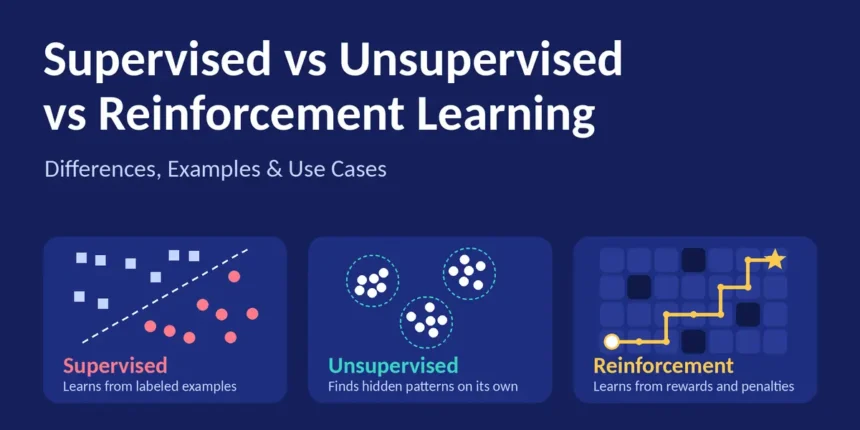
Supervised vs Unsupervised vs Reinforcement Learning
Machine learning systems can learn in fundamentally different ways depending on the information available during training and the type of problem they need to solve.
If a dataset contains known answers, a model can learn the relationship between inputs and those answers. This is supervised learning. If the data does not contain target labels and the objective is to discover structure, groups, representations, or other patterns, the problem may be approached with unsupervised learning. If a system must repeatedly interact with an environment, take actions, receive rewards or penalties, and improve its future decisions, reinforcement learning (RL) becomes a natural framework.
This distinction is more useful than simply asking whether an algorithm is “supervised” or “unsupervised.” In real machine learning systems, the choice depends on the available data, objective, feedback mechanism, evaluation method, and deployment environment.
Google describes supervised learning as training with labeled examples, while unsupervised learning focuses on finding patterns in typically unlabeled data. Reinforcement learning instead focuses on learning a policy that maximizes expected return while interacting with an environment.
Supervised vs Unsupervised vs Reinforcement Learning at a Glance
| Feature | Supervised Learning | Unsupervised Learning | Reinforcement Learning |
|---|---|---|---|
| Main objective | Predict a known target | Discover hidden structure | Learn decisions that maximize reward |
| Training feedback | Explicit labels | No target labels required | Rewards and environment feedback |
| Basic unit | Input + target | Input data | State, action, reward, next state |
| Typical tasks | Classification, regression | Clustering, dimensionality reduction, density estimation | Control, planning, sequential decision-making |
| Example | Spam detection | Customer segmentation | Game-playing agent |
| Output | Predicted class or value | Clusters, representations, patterns | Policy, value function, or action |
| Evaluation | Accuracy, F1, RMSE, MAE, ROC-AUC | Silhouette score, reconstruction error, stability | Return, success rate, regret, episode length |
| Common algorithms | Logistic regression, SVM, random forest, neural networks | K-means, DBSCAN, PCA, hierarchical clustering | Q-learning, SARSA, DQN, policy-gradient methods |
| Interaction with environment | Usually none during training | Usually none | Central to the learning process |
| Feedback timing | Usually immediate label | No explicit target feedback | Can be delayed |
The three approaches are not mutually exclusive in a production system. A modern pipeline can combine them. For example, an organization may use unsupervised learning to segment customers, supervised learning to predict churn, and reinforcement learning to optimize which action to take next.
What Is Supervised Learning?
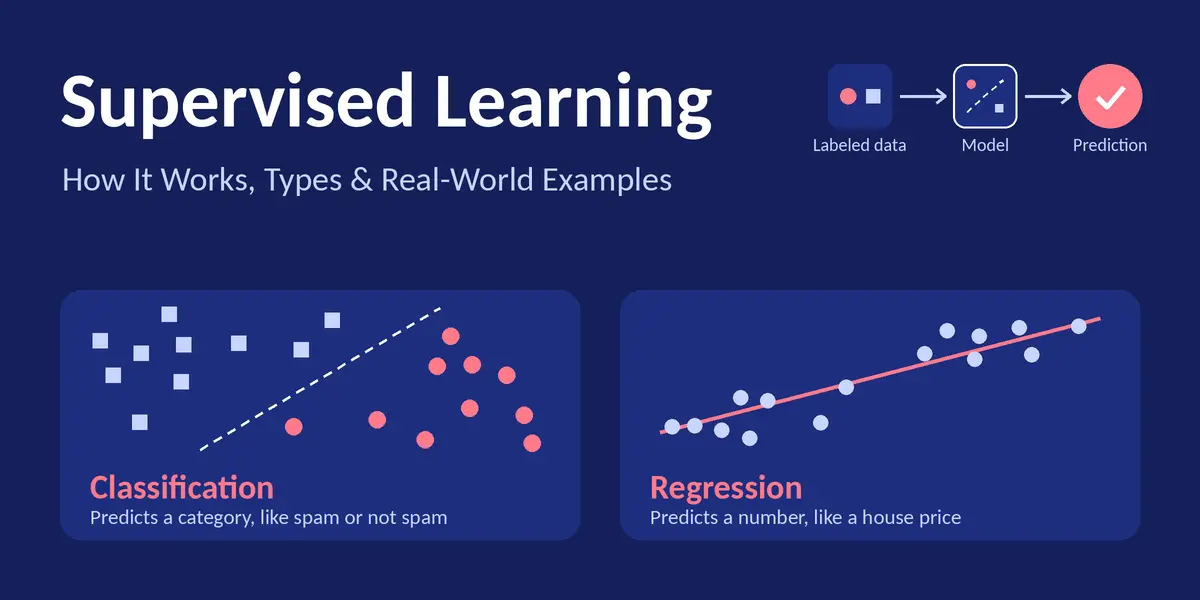
Supervised learning trains a model using examples where the desired target is known.
A training example can be represented as:
(X,y)(X,y)
where:
XX represents the input features
yy represents the target or label
The model attempts to learn a function:
f(X)→yf(X) \rightarrow y
During training, the model compares its prediction with the known target and adjusts its parameters to reduce an objective such as classification loss or regression error.
Google’s machine learning documentation describes supervised learning as learning from features and corresponding labels and then using the learned relationship to make predictions on new data.
Example: Email Spam Detection
Suppose an email dataset contains:
| Sender reputation | Contains suspicious URL | Number of links | Label | |
|---|---|---|---|---|
| Email A | 0.91 | No | 1 | Not spam |
| Email B | 0.12 | Yes | 8 | Spam |
| Email C | 0.24 | Yes | 6 | Spam |
| Email D | 0.87 | No | 0 | Not spam |
The label is already known.
The model learns from these examples and eventually receives a new email:
Sender reputation = 0.18
Suspicious URL = Yes
Number of links = 7
The model may predict:
Spam = 0.96 probability
This is supervised learning because the training examples contained known answers.
Types of Supervised Learning
The two classic supervised learning tasks are classification and regression. Scikit-learn defines classification as predicting discrete categories and regression as predicting continuous target values.
Classification
Classification predicts a category or class.
Examples include:
Spam vs not spam
Fraud vs legitimate transaction
Positive vs negative sentiment
Disease category
Image category
Customer churn vs no churn
Classification can be:
Fraud
├── Yes
└── No
Multiclass classification
Animal
├── Cat
├── Dog
└── Horse
Multilabel classification
A single example can belong to multiple labels.
For example, an article could be classified as:
AI
SEO
Technology
Machine Learning
Common Classification Algorithms
Logistic Regression
Decision Trees
Random Forest
Support Vector Machines
k-Nearest Neighbors
Gradient Boosting
Neural Networks
Regression
Regression predicts a numerical value.
For example, a house-price model could use:
Area
Bedrooms
Bathrooms
Location
Age
Parking
to predict:
Predicted price = ₹78,50,000
Other examples include:
Revenue forecasting
Demand prediction
Temperature prediction
Delivery-time estimation
Energy consumption forecasting
Property valuation
Common regression algorithms include:
Linear Regression
Ridge Regression
Lasso Regression
Random Forest Regression
Gradient Boosting Regression
Support Vector Regression
Supervised Learning Architecture
A typical supervised learning workflow looks like this:
Historical Data
      │
      ▼
Feature Engineering
      │
      ▼
Labeled Dataset
(X, y)
      │
      ▼
Train / Validation / Test Split
      │
      ▼
Model Training
      │
      ▼
Prediction
      │
      ▼
Compare Prediction With Label
      │
      ▼
Evaluation Metrics
      │
      ▼
Deploy Model
The important point is that the model has a target against which its predictions can be evaluated.
Supervised Learning Code Example
Here is a simple classification example using scikit-learn:
from sklearn.datasets import load_iris
from sklearn.model_selection import train_test_split
from sklearn.ensemble import RandomForestClassifier
from sklearn.metrics import accuracy_score

X, y = load_iris(return_X_y=True)

X_train, X_test, y_train, y_test = train_test_split(
    X,
    y,
    test_size=0.2,
    random_state=42
)

model = RandomForestClassifier(
    n_estimators=100,
    random_state=42
)

model.fit(X_train, y_train)

predictions = model.predict(X_test)

accuracy = accuracy_score(y_test, predictions)

print("Accuracy:", accuracy)
The important pattern is:
model.fit(X_train, y_train)
The model receives both features and known targets.
Scikit-learn’s supervised learning interface similarly uses fit(X, y) for training and predict(X) for inference.
What Is Unsupervised Learning?
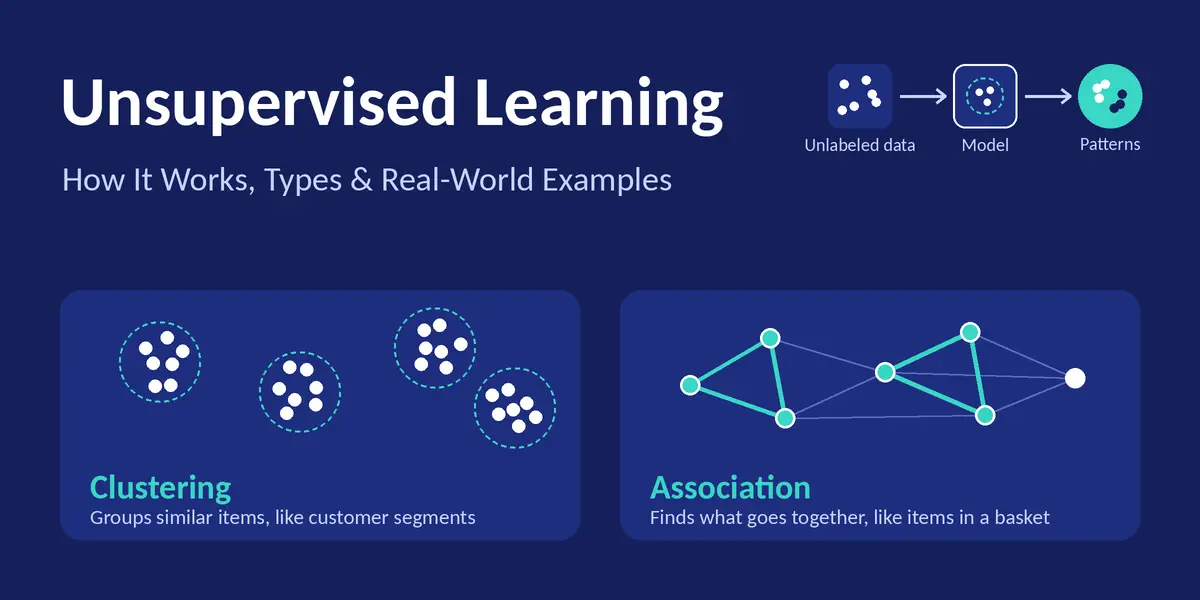
Unsupervised learning works with data where the target variable is not supplied to the algorithm.
Instead of learning:
X→yX \rightarrow y
the algorithm attempts to discover useful structure within:
XX
That structure might include:
Natural groups
Similarity relationships
Low-dimensional representations
Outliers
Data distributions
Latent patterns
Google describes unsupervised machine learning as training models to find patterns in typically unlabeled data, with clustering being one of its most common applications.
Example: Customer Segmentation
Imagine an e-commerce company has millions of customers but does not have predefined customer segments.
The dataset contains:
Customer ID
Monthly spending
Purchase frequency
Average order value
Product categories
Days since last purchase
There is no column saying:
Customer Type = Premium
Customer Type = Budget
Customer Type = Occasional
A clustering algorithm can attempt to identify natural groups.
For example:
Customer Data
      │
      ▼
Feature Scaling
      │
      ▼
Clustering Algorithm
      │
      ├── Cluster 1
      ├── Cluster 2
      ├── Cluster 3
      └── Cluster 4
The algorithm does not know beforehand that the groups are “premium” or “budget.” Those interpretations come later through analysis.
Important: Unsupervised Learning Does Not Simply “Predict the Output”
This is one area where simplified explanations can become misleading.
Unsupervised learning is not necessarily about predicting an unknown output.
For example, K-means clustering attempts to divide observations into groups based on similarity. PCA attempts to transform the representation into fewer dimensions while preserving important variation.
The result may be useful for prediction later, but the unsupervised algorithm itself does not necessarily produce a conventional target prediction.
Scikit-learn identifies clustering, dimensionality reduction, and density estimation among important unsupervised learning problems.
Major Types of Unsupervised Learning
1. Clustering
Clustering groups similar observations.
Popular algorithms include:
K-means
DBSCAN
Hierarchical clustering
Gaussian mixture models
HDBSCAN
Example:
Customer Dataset

       ● ●
     ● ● ●             ▲ ▲
      ● ●             ▲ ▲ ▲
                         ▲ ▲

   Cluster A          Cluster B
A company could later interpret these clusters as:
Cluster A → frequent low-value customers
Cluster B → infrequent high-value customers
The labels are interpretations added after the clustering process.
2. Dimensionality Reduction
Datasets can contain hundreds or thousands of features.
Dimensionality reduction methods transform the data into fewer dimensions.
A common method is Principal Component Analysis (PCA).
For example:
500 Features
     │
     ▼
    PCA
     │
     ▼
20 Components
     │
     ▼
Visualization / Modeling
PCA can be useful for visualization, preprocessing, compression, and exploratory analysis.
3. Anomaly Detection
Anomaly detection attempts to identify observations that differ substantially from normal patterns.
Examples include:
Unusual financial transactions
Network intrusions
Manufacturing defects
Abnormal sensor readings
Suspicious account behavior
One important edge case is that anomaly detection is not always strictly unsupervised. If confirmed anomaly labels exist, a supervised classification approach may be appropriate. If labels are absent, unsupervised or semi-supervised techniques may be considered.
Unsupervised Learning Code Example
A simple K-means example:
from sklearn.datasets import load_iris
from sklearn.cluster import KMeans
from sklearn.preprocessing import StandardScaler

X, _ = load_iris(return_X_y=True)

X_scaled = StandardScaler().fit_transform(X)

model = KMeans(
    n_clusters=3,
    random_state=42,
    n_init=10
)

clusters = model.fit_predict(X_scaled)

print(clusters)
Notice the difference from supervised learning:
model.fit(X, y)
becomes:
model.fit(X)
There is no target vector supplied to K-means.
What Is Reinforcement Learning?
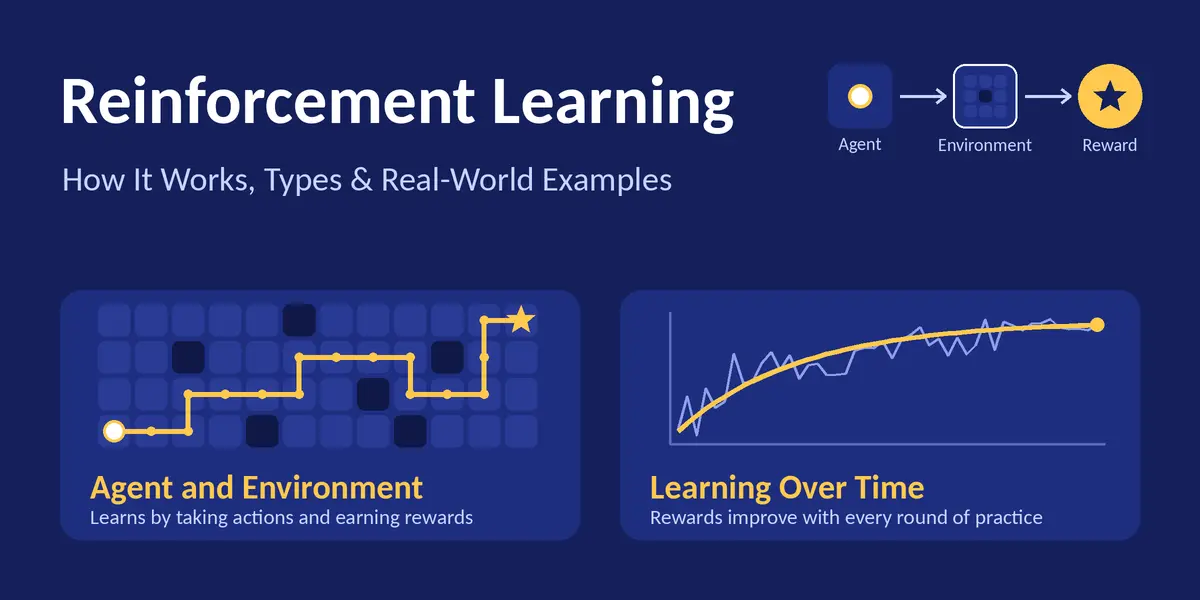
Reinforcement learning (RL) focuses on sequential decision-making.
Instead of giving a model the correct answer for every training example, an agent interacts with an environment.
A simplified loop is:
        ┌───────────────────────┐
        │       Environment     │
        └───────────┬───────────┘
                    │
                  State
                    │
                    ▼
              ┌───────────┐
              │   Agent   │
              └─────┬─────┘
                    │
                  Action
                    │
                    ▼
        ┌───────────────────────┐
        │       Environment     │
        └───────────┬───────────┘
                    │
             Reward + Next State
                    │
                    └────────────► Agent
Google defines reinforcement learning as a family of algorithms that learn an optimal policy with the goal of maximizing return while interacting with an environment.
The core components are:
Agent: the decision-making system
Environment: the world in which the agent operates
State: the current situation
Action: a decision available to the agent
Reward: numerical feedback from the environment
Policy: the strategy used to select actions
Return: accumulated future reward
A Simple Reinforcement Learning Example
Consider a robot navigating a warehouse.
The robot observes:
Current state:
Robot position
Nearby obstacles
Target location
Battery level
Possible actions:
Move Forward
Turn Left
Turn Right
Stop
The environment responds:
Reach target       → +100 reward
Move closer        → +5 reward
Hit obstacle       → -50 reward
Waste time         → -1 reward
The objective is not simply to predict a label.
The agent must learn a sequence of actions that produces a high long-term return.
Markov Decision Process
Many reinforcement learning problems are formulated as Markov Decision Processes (MDPs).
A simplified MDP contains:
(S,A,P,R,γ)(S,A,P,R,\gamma)
where:
SS = states
AA = actions
PP = transition dynamics
RR = reward function
γ\gamma = discount factor
The agent observes a state, chooses an action, receives feedback, and transitions to another state.
State Sₜ
   │
   ▼
Policy π
   │
   ▼
Action Aₜ
   │
   ▼
Environment
   │
   ├──── Reward Rₜ
   │
   └──── Next State Sₜ₊₁
Google’s glossary describes an MDP as a decision-making model involving sequences of states, actions, transitions, and numerical rewards.
Exploration vs Exploitation
One of the most important ideas in reinforcement learning is the exploration-exploitation trade-off.
Exploration
The agent tries actions it has not fully evaluated.
"What happens if I try something different?"
Exploitation
The agent chooses an action that currently appears to produce a high return.
"I already know this action works well."
An RL system that only exploits may never discover a better strategy.
An RL system that explores constantly may fail to use knowledge it has already acquired.
An example is an epsilon-greedy policy. Google defines epsilon-greedy behavior as choosing randomly with a specified probability and choosing greedily otherwise.
Common Reinforcement Learning Algorithms
Q-Learning
Q-learning estimates the value of taking an action in a particular state.
The Q-function can be represented as:
Q(s,a)Q(s,a)
It answers a question such as:
How valuable is action aa when the agent is in state ss?
Google describes Q-learning as learning the optimal Q-function for an MDP using the Bellman equation.
SARSA
SARSA is another temporal-difference reinforcement learning method.
Its name comes from the sequence:
State
Action
Reward
Next State
Next Action
Deep Q-Networks
A Deep Q-Network (DQN) uses a neural network to approximate action values instead of storing a simple Q-table.
A landmark DeepMind study demonstrated a DQN learning directly from high-dimensional visual input and game scores across 49 Atari games.
Policy Gradient Methods
Instead of primarily learning action values, policy-gradient methods directly optimize a parameterized policy.
Modern RL also includes families such as:
Actor-critic methods
Proximal Policy Optimization
Advantage Actor-Critic
Soft Actor-Critic
Deep deterministic policy-gradient methods
Reinforcement Learning Architecture
A practical RL system can look like this:
             ┌───────────────────┐
             │    Environment    │
             └─────────┬─────────┘
                       │
                 State / Reward
                       │
                       ▼
              ┌────────────────┐
              │ State Encoder  │
              └───────┬────────┘
                      │
                      ▼
              ┌────────────────┐
              │ Policy / Value │
              │     Network    │
              └───────┬────────┘
                      │
                    Action
                      │
                      ▼
             ┌───────────────────┐
             │    Environment    │
             └───────────────────┘
For a DQN-style system, an additional replay buffer and target network can be used to improve training stability. Google’s ML glossary describes experience replay as storing state transitions and sampling them later for training.
Supervised vs Unsupervised vs Reinforcement Learning: Core Difference
The easiest way to remember the distinction is:
Supervised Learning
"What is the correct answer?"

Unsupervised Learning
"What structure exists in this data?"

Reinforcement Learning
"What action should I take to maximize future reward?"
This difference determines the training data and architecture.
Detailed Comparison
| Criteria | Supervised Learning | Unsupervised Learning | Reinforcement Learning |
|---|---|---|---|
| Training signal | Label/target | Data structure | Reward |
| Target available? | Yes | Usually no | No fixed target for every state |
| Learns from | Examples | Patterns and relationships | Experience |
| Feedback | Direct | Usually absent | Often delayed |
| Interaction | Usually static dataset | Usually static dataset | Interactive environment |
| Main objective | Predict target | Discover structure | Maximize cumulative return |
| Typical output | Class/value | Cluster/representation/anomaly | Policy/action/value |
| Main challenges | Label quality, overfitting | Choosing meaningful structure | Reward design, exploration, instability |
| Typical metrics | Accuracy, F1, RMSE, MAE, ROC-AUC | Silhouette, reconstruction error, cluster stability | Return, success rate, regret |
| Example | Credit-risk prediction | Customer segmentation | Robot navigation |
Real-World Use Cases
Supervised Learning Use Cases
Fraud Detection
Historical transactions can be labeled:
Legitimate
Fraudulent
A classifier can learn to estimate the probability that a new transaction is fraudulent.
Medical Image Classification
Images may be labeled by experts and used to train a model to classify specific findings.
Demand Forecasting
Historical sales and contextual features can be used to predict future demand.
Spam Detection
Known spam and legitimate messages provide labeled training examples.
Unsupervised Learning Use Cases
Customer Segmentation
Companies can group customers based on behavior without manually assigning every customer to a predefined segment.
Recommendation Systems
Unsupervised techniques can help discover similarity between users, products, documents, or other entities.
Anomaly Detection
Unusual observations can be identified when confirmed labels are unavailable.
Exploratory Data Analysis
Clustering and dimensionality reduction can help analysts understand large datasets.
Google specifically notes that clustering can help reveal groups when useful labels are scarce or absent.
Reinforcement Learning Use Cases
Robotics
A robot can learn control policies through interaction with a simulated or physical environment.
Games
Games provide clearly defined actions, states, rewards, and terminal conditions, making them useful RL environments.
Resource Allocation
RL can potentially optimize sequential decisions where current actions affect future outcomes.
Recommendation and Ranking
Sequential recommendation problems can sometimes be formulated around long-term user outcomes rather than a single immediate prediction.
Industrial Control
An RL agent can be trained to control processes where actions influence future system states.
However, deploying RL in a physical environment requires careful attention to safety, reward design, exploration constraints, and simulation-to-real-world differences.
One Problem Can Use More Than One Learning Paradigm
A common mistake is to assume that a real-world project must use exactly one learning method.
Consider an e-commerce company.
Customer Data
     │
     ├──────────────► Unsupervised
     │                 Customer Segmentation
     │
     ├──────────────► Supervised
     │                 Churn Prediction
     │
     └──────────────► Reinforcement Learning
                       Offer / Action Optimization
The same organization can use all three approaches for different parts of its machine learning architecture.
Hybrid Machine Learning Architecture
A more realistic production system could look like this:
                    Raw Customer Data
                           │
                           ▼
                  Data Processing Layer
                           │
            ┌──────────────┼──────────────┐
            │              │              │
            ▼              ▼              ▼
      Unsupervised      Supervised       RL
       Clustering       Prediction     Decision
            │              │              │
            ▼              ▼              ▼
      User Segment      Churn Score    Next Action
            │              │              │
            └──────────────┼──────────────┘
                           ▼
                    Decision System
                           │
                           ▼
                       Customer
                           │
                           ▼
                     New Feedback
This is closer to how complex machine learning platforms can be designed than treating supervised, unsupervised, and reinforcement learning as completely isolated categories.
How to Choose the Right Learning Type
Use the following decision framework.
| Question | If Yes | Likely Approach |
|---|---|---|
| Do you have reliable target labels? | Predict a known outcome | Supervised |
| Is the target continuous? | Predict a number | Supervised regression |
| Is the target categorical? | Predict a class | Supervised classification |
| Do you want to discover natural groups? | Segment similar observations | Unsupervised clustering |
| Do you need fewer dimensions? | Compress or visualize features | Unsupervised dimensionality reduction |
| Do you need to detect unusual observations without labels? | Find deviations | Unsupervised/anomaly detection |
| Does an agent repeatedly take actions? | Sequential decisions | Reinforcement learning |
| Does each action affect future states? | Long-term consequences matter | Reinforcement learning |
| Do you receive rewards or penalties? | Learn from environmental feedback | Reinforcement learning |
Benchmarking the Three Approaches
A meaningful benchmark should not compare these learning paradigms using one generic metric because they solve different types of problems.
Supervised Learning Benchmark
For classification:
Accuracy
Precision
Recall
F1-score
ROC-AUC
PR-AUC
Log loss
For regression:
MAE
MSE
RMSE
R2R^2
MAPE where appropriate
Scikit-learn provides separate metric families for classification and regression rather than treating all predictive problems as equivalent.
Unsupervised Learning Benchmark
Depending on the task:
Silhouette score
Calinski-Harabasz score
Davies-Bouldin score
Reconstruction error
Cluster stability
Adjusted Rand Index when external ground-truth labels are available
A critical point is that clustering quality cannot always be judged by a single numerical score. A mathematically clean cluster can still be useless for the business problem.
Reinforcement Learning Benchmark
Useful measures include:
Average episodic return
Success rate
Episode length
Cumulative reward
Constraint violations
Regret
Training stability
Sample efficiency
For RL, a model that achieves a high training reward but fails in new environments may not be useful.
Edge Cases You Should Understand
What If Only a Small Part of the Data Is Labeled?
This does not automatically mean you must choose unsupervised learning.
You may consider:
Semi-supervised learning
Active learning
Self-training
Transfer learning
Weak supervision
Google’s ML glossary distinguishes self-supervised learning from traditional unsupervised learning and notes that self-supervised approaches can create surrogate labels from unlabeled examples.
What If the Labels Are Wrong?
More labeled data does not automatically produce a better supervised model.
If labels are systematically incorrect, the model may learn the labeling process rather than the desired concept.
For example:
100,000 training records
+
20% noisy labels
=
Potentially misleading supervision
Label quality, coverage, consistency, and representativeness can matter as much as dataset size.
What If the Dataset Has No Labels?
Start by defining what you actually want.
If you want:
"Find groups"
consider clustering.
If you want:
"Find unusual observations"
consider anomaly detection.
If you want:
"Compress 200 features into 10 useful components"
consider dimensionality reduction.
If you ultimately need:
"Predict a specific outcome"
you may eventually need labeled data.
What If the Problem Involves Actions?
A sequential decision problem is not automatically reinforcement learning.
For example, if you have historical records containing:
State
Action
Outcome
you might initially use supervised learning to model outcomes or learn from logged behavior.
RL becomes especially relevant when the system can interact with an environment and the objective involves optimizing future cumulative rewards.
This distinction is important because offline datasets and interactive environments create different learning and evaluation problems.
Common Mistakes
Mistake 1: Calling Every Neural Network Supervised
Neural networks are model architectures, not a learning paradigm by themselves.
A neural network can be used in supervised learning, unsupervised or self-supervised learning, and reinforcement learning.
Mistake 2: Calling PCA a Classification Algorithm
PCA is primarily a dimensionality-reduction technique.
It does not classify examples into predefined target classes.
Mistake 3: Saying K-means Predicts Labels
K-means assigns observations to clusters, but cluster IDs such as:
Cluster 0
Cluster 1
Cluster 2
are not automatically meaningful semantic labels.
A data scientist must interpret what those clusters represent.
Mistake 4: Treating Reinforcement Learning as “Learning Without Data”
RL still needs experience.
That experience can come from:
Simulators
Historical trajectories
Human demonstrations
Real-world interaction
Game environments
Robotic environments
The key difference is that the learning signal comes from interaction and rewards rather than a fixed correct label for every training example.
Mistake 5: Confusing Exploration With an RL Algorithm
Exploration is a strategy or requirement in many RL problems.
It is not itself a separate “type of reinforcement learning.”
Mistake 6: Assuming Higher Accuracy Means Better RL
Accuracy is usually not the primary metric for an RL policy.
An RL system may need to optimize:
Gt=Rt+1+γRt+2+γ2Rt+3+⋯G_t = R_{t+1} + \gamma R_{t+2} + \gamma^2R_{t+3} + \cdots
where GtG_t represents the return from time tt.
The agent therefore cares about future consequences, not only the correctness of one prediction.
Google defines return in reinforcement learning as the sum of expected rewards, with future rewards discounted according to the discount factor.
Supervised vs Unsupervised vs Reinforcement Learning Example
Imagine a delivery company wants to improve operations.
Problem 1: Predict Late Deliveries
Input:
Distance
Weather
Traffic
Driver history
Time of day
Target:
Late = Yes / No
Approach: Supervised classification
Problem 2: Discover Delivery Patterns
Input:
Delivery locations
Delivery times
Package sizes
Customer frequency
No predefined segment exists.
Approach: Unsupervised clustering
Problem 3: Optimize Driver Routing
The system must repeatedly choose actions:
Choose route A
Observe traffic
Choose route B
Observe delivery time
Receive reward
The action affects future states.
Approach: Reinforcement learning
This example demonstrates why the three approaches are distinguished by the learning problem, not simply by the algorithm’s name.
Technical Architecture Comparison
SUPERvised
────────────────────────────────
Features ──► Model ──► Prediction
                ▲
                │
             Label
                │
          Loss / Error
                │
             Update


UNSUPERVISED
────────────────────────────────
Features ──► Model ──► Structure
                │
                ├── Clusters
                ├── Embeddings
                ├── Components
                └── Anomalies


REINFORCEMENT
────────────────────────────────
             Environment
                  │
                State
                  │
                  ▼
                Agent
                  │
                Action
                  │
                  ▼
             Environment
                  │
           Reward + State
                  │
                  └────► Agent
The Simplest Mental Model
Think of the three approaches as three different questions.
Supervised Learning
“Here are examples with answers. Can you learn to predict the answer for a new example?”
Unsupervised Learning
“Here is a large dataset without target answers. Can you discover useful structure?”
Reinforcement Learning
“You need to make a sequence of decisions. Can you learn which actions produce better long-term outcomes?”
Key Differences Between Supervised, Unsupervised, and Reinforcement Learning
| Learning Type | What the Model Receives | What It Learns | Typical Result |
|---|---|---|---|
| Supervised | Features + labels | Mapping from inputs to targets | Prediction |
| Unsupervised | Mostly unlabeled features | Structure in the data | Clusters or representations |
| Reinforcement | States, actions, rewards, transitions | Decision policy/value | Actions and long-term strategy |
Final Takeaway
Supervised, unsupervised, and reinforcement learning solve different machine learning problems.
Supervised learning is appropriate when you have reliable target labels and want to predict known outcomes such as classes or numerical values.
Unsupervised learning is useful when labels are missing and the goal is to discover structure, groups, representations, or anomalies in the data.
Reinforcement learning is designed for sequential decision-making where an agent interacts with an environment, receives feedback, and learns a policy intended to maximize long-term return.
The most important distinction is therefore not:
Which algorithm is more advanced?
It is:
What information do I have?
What am I trying to learn?
How does the system receive feedback?
Does the current decision affect future outcomes?
Once those questions are clear, selecting an appropriate machine learning paradigm becomes much easier.

AiVoogle – AI Tutorials & AI Tools
AiVoogle is an AI-focused platform sharing practical AI tutorials, AI tools, guides, reviews, and the latest trends in artificial intelligence. Our goal is to make AI simple, useful, and accessible for everyone—from beginners and creators to marketers, developers, and businesses.
The AiVoogle team researches and covers the latest AI tools and technologies to help readers discover the right tools and learn how to use AI effectively.
Focus: AI Tutorials | AI Tools | AI Guides | AI News | AI Reviews