
President Donald Trump has directed the U.S. executive branch to replace the term “Artificial Intelligence” (AI) with “Super Intelligence” (SI) in a broad range of official government communications.
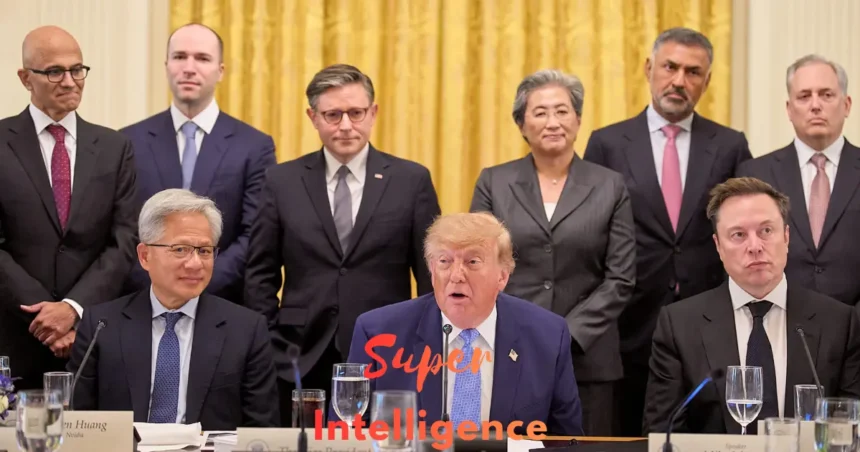
The move came on September 29, 2026, as Trump signed an executive order titled “Inaugurating the Era of Super Intelligence.” On the same day, Trump also announced a voluntary agreement with several major technology executives aimed at establishing additional safety controls for advanced AI systems.
The White House says the terminology change is intended to reflect what the administration describes as the rapidly advancing capabilities of modern AI technology. However, the executive order does not mean that AI has been legally or globally renamed. For now, “Super Intelligence” is the terminology the Trump administration has instructed the U.S. executive branch to use in specified settings.
Trump Says AI Has Entered a New Era
The executive order argues that modern AI systems have moved beyond simply imitating or automating individual aspects of human intelligence.
According to the White House, today’s frontier systems are increasingly being used to amplify human creativity and capabilities across areas including science, medicine and other fields.
The administration therefore argues that the traditional term “Artificial Intelligence” no longer fully captures the potential of these technologies.
The order states that the federal government’s terminology should reflect what it describes as the transformative capabilities of these systems. It consequently establishes “Super Intelligence” and “SI” as the preferred terms for the executive branch.
The White House fact sheet similarly describes SI as a way of recognizing what the administration considers the expanding technological frontier and its potential economic and scientific impact.
What Does the Executive Order Actually Change?
The most important detail is that the order applies to the U.S. executive branch.
Federal departments and agencies are directed, to the maximum extent permitted by law, to use “Super Intelligence” and “SI” instead of “Artificial Intelligence” and “AI” in:
- Official correspondence
- Public communications
- Government websites
- Reports
- Policy documents
- Other non-statutory executive-branch documents
The order also says that previously issued regulations, presidential actions, contracts, grants and historical documents do not need to be changed.
This means the announcement should not be interpreted as a worldwide renaming of artificial intelligence.
Technology companies, researchers, universities and governments outside the scope of the order are not automatically required to replace the term AI with SI.
SI Currently Uses the Existing Federal AI Definition
Another significant detail appears in Section 3 of the executive order.
For purposes of the order, “Super Intelligence” and “SI” currently refer to the technologies and systems covered by the existing federal statutory definition of artificial intelligence.
In other words, the order initially uses a new name for the existing statutory category rather than immediately creating an entirely separate legal classification for a new type of intelligence.
However, that could change.
The order gives the Assistant to the President for Science and Technology 60 days to submit proposed legislative language for a federal definition of “Super Intelligence” and “SI.”
That proposal must consider whether the new definition should modify, expand or replace the existing statutory definition of artificial intelligence.
This makes the 60-day review an important next step in the administration’s policy.
White House Announces Super Intelligence Accord
The terminology change was announced alongside a separate agreement involving Trump and executives from several leading technology companies.
The White House Accord on Super Intelligence is a voluntary framework focused on safety controls for advanced AI systems.
The signatories included:
- Elon Musk of xAI
- Mark Zuckerberg of Meta
- Jensen Huang of Nvidia
- Dario Amodei of Anthropic
- Sundar Pichai of Google
- Greg Brockman of OpenAI
- Donald Trump
The accord focuses on internal controls, monitoring and independent assessment rather than creating a new federal regulatory system.
Trump described the agreement as a form of protection and compared it to a constitution, while reporting from AP and Reuters characterized the framework as voluntary.
Four Layers of AI Safety Controls
The accord outlines four main layers of controls and oversight.
1. Internal Controls
Participating companies are expected to establish robust internal controls for their AI systems.
The framework covers monitoring of potential risks and calls for safeguards intended to prevent AI systems from accessing technical systems in unintended ways.
Cybersecurity, biosecurity and chemical-related risks are among the areas addressed by the framework.
2. Internal Oversight
Companies are also expected to have an internal team responsible for overseeing the operation of their controls and monitoring systems.
The goal is to create an additional layer of organizational oversight rather than relying solely on the teams developing the AI systems.
3. Independent External Assessment
The accord calls for companies to work with an independent external auditor or evaluator.
These external assessments are intended to determine whether the companies’ AI controls and monitoring systems are operating as intended.
4. Board-Level Oversight
The fourth layer involves an independent committee of the company’s board of directors.
The committee would receive and review reports from internal teams and external auditors and oversee the handling of identified issues.
The Accord Is Voluntary
One of the most important aspects of the agreement is its legal status.
The accord is voluntary. It does not itself create federal penalties or establish a new legally enforceable AI regulatory regime.
Reporting by Al Jazeera notes that the agreement does not give the government an enforcement role under the pact and does not require companies to publicly release their audit results. The companies retain significant discretion over how they implement the safeguards.
The document does, however, leave open the possibility that some of its principles could eventually be incorporated into laws or regulations.
Why the Super Intelligence Name Matters
The terminology change is significant because “superintelligence” already has a meaning within discussions about advanced AI.
In AI research and technology discussions, superintelligence is generally associated with hypothetical systems that substantially exceed human cognitive abilities.
The Trump administration’s executive order initially uses “Super Intelligence” differently. It applies the term to technologies covered by the existing statutory definition of AI.
That creates an important distinction between the administration’s new government terminology and the way researchers may use the term “superintelligence.”
The administration has indicated that it wants to develop a more specific federal definition in the future.
The White House Links SI to U.S. Innovation
The White House is presenting the terminology change as part of a larger effort to maintain U.S. leadership in advanced AI technologies.
Its fact sheet points to several initiatives, including the Genesis Mission, which the administration says has received more than $5 billion in announced federal support.
The White House also points to its July 2025 America’s AI Action Plan, which identified more than 90 federal actions related to AI innovation, infrastructure and international leadership.
The administration’s March 2026 National Super Intelligence Policy Framework is also cited as part of this broader strategy.
These claims represent the White House’s description of its own technology policy and priorities.
Elon Musk and Other Tech Leaders Join the Accord
The White House meeting brought together executives from some of the world’s largest technology and AI companies.
Among the signatories, Elon Musk, Mark Zuckerberg, Jensen Huang, Dario Amodei, Sundar Pichai and Greg Brockman represent companies involved in different parts of the AI ecosystem, including model development, cloud and computing infrastructure, chips and consumer technology.
The agreement reflects an attempt to establish common safety practices across companies developing increasingly capable AI systems. Reuters reported that the companies agreed to work with independent auditors to assess whether their AI controls were functioning as intended.
At the same time, the voluntary nature of the agreement means its practical impact will depend heavily on how participating companies implement the proposed controls.
What Happens Next?
The next major step is the federal definition of “Super Intelligence.”
The executive order gives the Assistant to the President for Science and Technology 60 days to prepare proposed legislative language.
That work is expected to consider whether the term should:
- Modify the existing federal AI definition
- Expand the existing definition
- Replace parts of the existing definition
- Require additional changes to federal laws and executive actions
The resulting proposal could therefore become more important than the terminology change itself if the administration seeks congressional action.
For now, however, the existing order primarily changes the language used by the executive branch.
AI Has Not Disappeared
Despite the headline-grabbing terminology change, Artificial Intelligence remains the standard term used throughout the global technology industry and AI research community.
The Trump administration’s action changes terminology within the U.S. executive branch. It does not automatically rename AI products, research fields, companies or technologies around the world.
The distinction is important for anyone following the development of advanced AI.
For the U.S. government, the preferred terminology is now “Super Intelligence” and “SI.” For much of the technology industry and research community, the established term remains “Artificial Intelligence” or “AI.”
The coming federal definition and any potential legislative changes will determine whether the administration’s terminology eventually develops into a broader legal or policy category.
For now, the announcement marks a notable shift in how the U.S. executive branch describes the rapidly developing field of artificial intelligence.
Sources :
White House: Inaugurating the Era of Super Intelligence
White House Fact Sheet: President Donald J. Trump Inaugurates the Era of Super Intelligence
Reuters: Trump, AI CEOs sign voluntary safety pact
AP: Trump says top tech firms have signed accord to self-police AI development

AiVoogle – AI Tutorials & AI Tools
AiVoogle is an AI-focused platform sharing practical AI tutorials, AI tools, guides, reviews, and the latest trends in artificial intelligence. Our goal is to make AI simple, useful, and accessible for everyone—from beginners and creators to marketers, developers, and businesses.
The AiVoogle team researches and covers the latest AI tools and technologies to help readers discover the right tools and learn how to use AI effectively.
Focus: AI Tutorials | AI Tools | AI Guides | AI News | AI Reviews